


Editors Pick
Latest Article
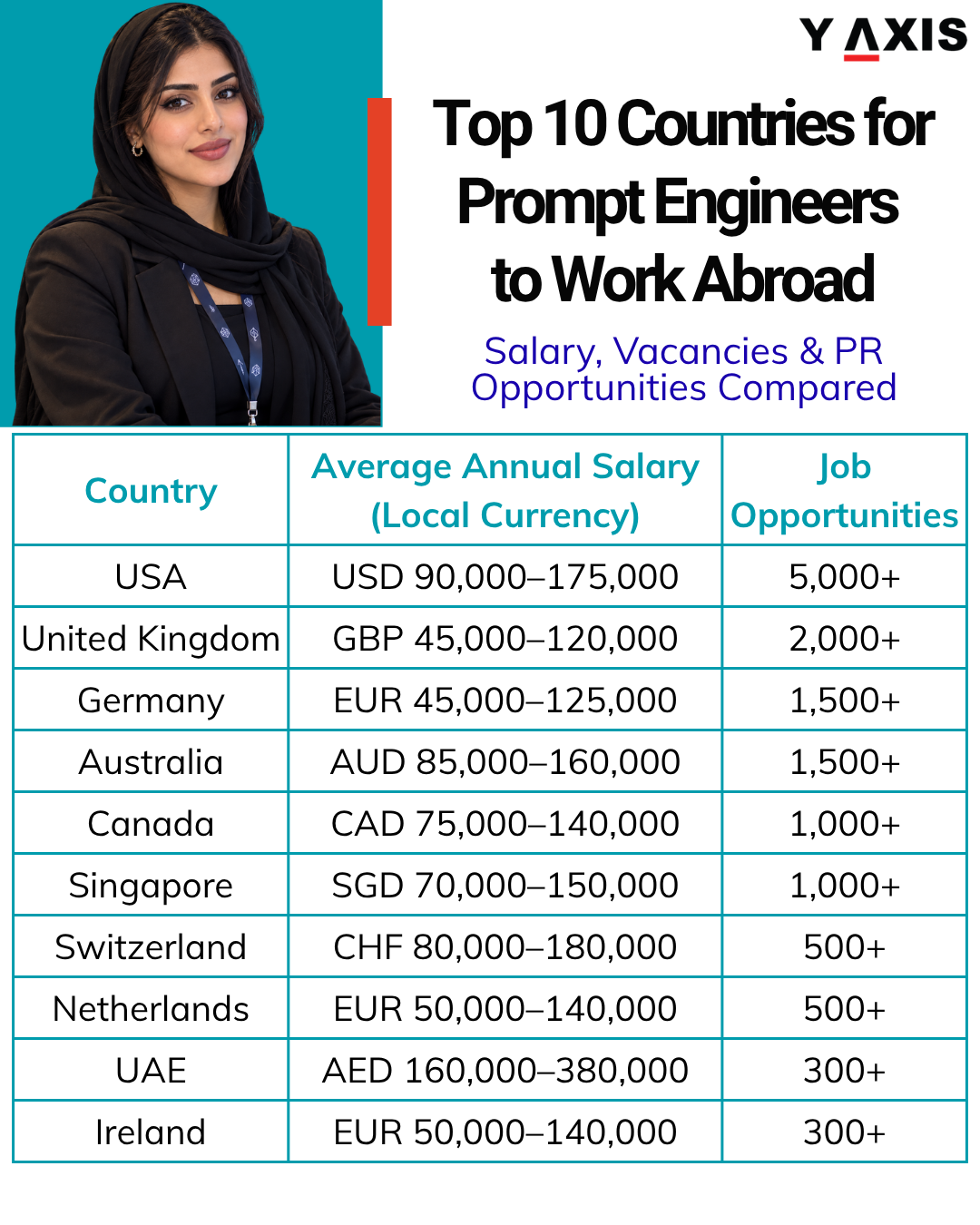
Top 10 Countries for Prompt Engineers to Work Abroad: Salary, Demand & PR Opportunities Compared
Top 10 Countries for Prompt Engineers to Work Abroad: Salary, Demand & PR Opportunities Compared
The best countries for Prompt Engineers to work abroad are the USA, Canada, Germany, Australia, the UK, Singapore, the UAE, Switzerland, Ireland and the Netherlands. These countries offer Prompt Engineer jobs with competitive salaries, strong job demand, work visa options and permanent residence pathways.
The global Generative AI market is projected to reach USD 1.26 trillion by 2034, growing at a CAGR of 29.3%. This growth is driving demand for Prompt Engineers with expertise in prompt design, large language model (LLM) optimisation, AI automation and Generative AI applications. With demand for these skills increasing across major technology markets, Prompt Engineers have more opportunities to secure well-paid roles and build long-term careers abroad.
*Want to work abroad? Sign up with Y-Axis Resume Marketing Services to find right job faster.
Benefits of Working Abroad as a Prompt Engineer
Working abroad as a Prompt Engineer offers higher salaries, advanced AI projects, international experience and access to leading technology markets. AI and big data are projected to be among the fastest-growing skills through 2030.
- Higher Salaries: Earn competitive pay in high-demand markets.
- Advanced AI Projects: Gain experience with LLMs, AI agents and automation.
- Global Experience: Work with international companies and technology teams.
- Career Growth: Move into LLM Engineer, AI Engineer or Generative AI Engineer roles.
- AI Hubs: Access leading centres for AI research and innovation.
- Visa and PR Options: Explore skilled-worker visas and permanent residence pathways.
How to Choose the Right Country for Prompt Engineer Jobs Abroad?
The right country for Prompt Engineer jobs depends on salary levels, job demand, work visa requirements, career growth and permanent residence options. Compare these factors with the cost of living and your qualifications to identify the country that best matches your career goals.
- Job Demand: Check the number of Prompt Engineer, LLM and Generative AI roles available.
- Salary: Compare average salaries with taxes and living costs.
- Visa Requirements: Check whether your qualifications and experience meet the work visa criteria.
- Career Growth: Look for markets with opportunities to move into advanced AI and LLM roles.
- Cost of Living: Compare housing, transport, healthcare and other essential expenses.
- PR Pathways: Check eligibility requirements and timelines for permanent residence.
Top 10 Countries for Prompt Engineers to Work Abroad
The USA, Canada, Germany, Australia and the UK are among the leading destinations for Prompt Engineers seeking jobs abroad, with strong demand for Generative AI, large language models (LLMs), AI agents and automation. The World Economic Forum projects that AI and information-processing technologies will create 11 million jobs by 2030, supporting continued demand for AI skills worldwide. Prompt Engineers can earn more than AED 200,000 per year in leading markets, while strong AI ecosystems, work visa options and permanent residence pathways provide opportunities to build rewarding long-term careers abroad.
| Country | Average Annual Salary (Local Currency) |
Estimated Prompt Engineer Job Opportunities |
|---|---|---|
| USA | USD 90,000–175,000 | 5,000+ |
| Canada | CAD 75,000–140,000 | 1,000+ |
| Australia | AUD 85,000–160,000 | 1,500+ |
| Germany | EUR 45,000–125,000 | 1,500+ |
| UK | GBP 45,000–120,000 | 2,000+ |
| Singapore | SGD 70,000–150,000 | 1,000+ |
| UAE | AED 160,000–380,000 | 300+ |
| Netherlands | EUR 50,000–140,000 | 500+ |
| Ireland | EUR 50,000–140,000 | 300+ |
| South Korea | KRW 50 million–100 million | 200+ |
*Want to work abroad? Sign up with Y-Axis Resume Marketing Services to find right job faster.
Best Countries for Prompt Engineers to Work and Settle Abroad
Canada, Australia, Germany, the UK and Ireland are among the top destinations for Prompt Engineers who want to work abroad and build a long-term future. These countries combine demand for Prompt Engineering, LLM and Generative AI skills with skilled-worker visa routes, competitive salaries and pathways to permanent residence, making them strong options for Prompt Engineers planning to settle abroad.
Prompt Engineer Jobs in the USA
The USA has a large market for Prompt Engineering, with opportunities centered on LLMs, Generative AI, RAG and AI agents. More than 22,000 US AI job postings included prompt engineering skills, showing strong demand for this specialised role. Prompt Engineers develop prompts, test LLM responses, evaluate model outputs, optimise chatbots and build AI agent workflows for technology, software, finance and healthcare companies. The H-1B visa provides an employer-sponsored work route, while EB-2 and EB-3 provide employment-based pathways to permanent residence. Prompt Engineers can gain experience with advanced LLM systems and progress into LLM Engineer, Generative AI Engineer and AI Agent Engineer roles in the USA.
| Factor | Details |
|---|---|
| Prompt Engineer Job Market & Job Vacancies for the Next Decade | The USA is expected to have more than 5,000 Prompt Engineer job opportunities over the next decade, with roles covering prompt optimisation, LLM applications, Generative AI, AI agents, conversational AI and automation. |
| Investment in Artificial Intelligence & AI Research | The USA attracts nearly USD 600 billion in AI investment, supporting the development of LLMs, Generative AI applications, AI agents and automated workflows and creating demand for Prompt Engineering expertise. |
| Top Companies Hiring Prompt Engineers | OpenAI, Google, Microsoft, Amazon, Meta, Anthropic and IBM hire for roles involving prompt development, LLM evaluation, AI agents, Generative AI and AI-powered applications. |
| Top Cities for Prompt Engineer Jobs | San Francisco Bay Area, Seattle, New York City, Boston, Austin and Washington, DC are major locations for Prompt Engineer jobs, with opportunities in LLM development, Generative AI, enterprise AI and AI research. |
| In-Demand Prompt Engineer Roles & Skills | Common roles include Prompt Engineer, Prompt Designer, LLM Specialist, Generative AI Specialist and AI Engineer. Key skills include prompt optimisation, LLM evaluation, RAG, Python, few-shot prompting, AI agents, API integration and model testing. |
| Work Visa Options | The H-1B visa provides an employer-sponsored route for Prompt Engineers working in specialised AI and technology roles. The O-1A visa is another option for candidates with recognised achievements in AI, research or technology. |
| Fast-Track Hiring Options | USCIS Premium Processing can speed up processing for eligible immigration petitions. Candidates with AI research, publications, patents or significant industry achievements may also consider the O-1A visa. |
| PR / Long-Term Residence Opportunities | Prompt Engineers can pursue EB-2, EB-2 National Interest Waiver (NIW), EB-3 and EB-1A Green Card pathways, covering employer-sponsored, advanced-degree, national-interest and extraordinary-ability routes. |
| Eligibility for Dependents | H-1B holders can generally bring their spouse and unmarried children under 21 on H-4 status. O-1A holders can bring their spouse and unmarried children under 21 on O-3 status. |
| Benefits for Family Members | H-4 children can study in the USA, while H-4 spouses may obtain employment authorisation through the H-4 EAD programme when they meet its requirements. O-3 dependents can study but generally cannot work. |
Prompt Engineer Jobs in Canada
Canada is creating more opportunities for Prompt Engineers as LLM and Generative AI applications expand across key industries. Prompt Engineers develop prompts, test LLM responses, evaluate AI outputs, optimise chatbots and build RAG and AI agent workflows across technology, finance, healthcare, consulting and software. More than 250,000 AI-related jobs are projected to be added by 2031, supporting continued demand for Prompt Engineering skills. Express Entry, Provincial Nominee Programs (PNPs) and employer-specific work permits provide routes to work and permanent residence. Prompt Engineers can strengthen their LLM expertise in Canada and progress into LLM Engineer, Generative AI Engineer and AI Product roles while building long-term careers.
| Factor | Details |
|---|---|
| Prompt Engineer Job Market & Job Vacancies for the Next Decade | Canada is expected to have more than 1,000 Prompt Engineer job opportunities over the next decade. Roles can involve prompt development and optimisation, LLM testing, AI output evaluation, AI agents, conversational AI and LLM workflow automation. |
| Investment in Artificial Intelligence & AI Research | Canada has committed CAD 2.4 billion to AI infrastructure, research, startups, talent development and business adoption. This investment supports the development of Generative AI, LLMs, AI assistants and AI agents that require prompt design and testing. |
| Top Companies Hiring Prompt Engineers | Cohere, Netomi, MEDFAR and MarkiTech hire for Prompt Engineer and related positions involving LLMs, Generative AI, AI agents and AI-powered software. |
| Top Cities for Prompt Engineer Jobs | Toronto, Montreal, Vancouver and Ottawa are major AI and technology centres, offering Prompt Engineer opportunities in LLM development, Generative AI products, enterprise software and AI research. |
| In-Demand Prompt Engineer Roles & Skills | Common positions include Prompt Engineer, Senior Prompt Designer, LLM Specialist and Generative AI Specialist. Key skills include prompt optimisation, LLM evaluation, few-shot prompting, Python, RAG, AI agents, model testing, chatbot development and API integration. |
| Work Visa Options | An employer-specific work permit allows a Prompt Engineer to work for the Canadian employer named on the permit. LMIA-based permits are a common route, while intra-company transfers and certain international agreements can provide LMIA-exempt options. |
| Fast-Track Hiring Options | The Global Talent Stream (GTS) offers faster processing for eligible technology positions. The Canadian employer must complete the required application and Labour Market Benefits Plan before the Prompt Engineer applies for a work permit. |
| PR / Long-Term Residence Opportunities | Express Entry includes the Federal Skilled Worker Program and Canadian Experience Class. Provincial Nominee Programs (PNPs) provide another pathway to permanent residence through provincial nomination. |
| Eligibility for Dependents | A permanent residence application can include a spouse or common-law partner and dependent children under 22. All accompanying family members must be declared in the application. |
| Benefits for Family Members | A spouse or common-law partner may be able to obtain an open work permit, while dependent children can study in Canada with the required authorisation. |
*Want to Work in Canada? Let Y-Axis guide you through application process.
Prompt Engineer Jobs in Germany
Germany's growing use of LLMs and Generative AI is opening opportunities for Prompt Engineers in software and industrial applications. Prompt Engineering work includes prompt optimisation, LLM testing, response evaluation, RAG and AI agent workflows. Prompt Engineers can apply these skills across software, automotive technology and finance, where companies are developing Generative AI solutions. Germany’s ICT sector is expected to need around 128,000 additional skilled workers by 2030. The EU Blue Card provides a work and residence route, while the Skilled Worker visa provides another pathway for IT roles. EU Blue Card holders can obtain permanent settlement after 21 months with B1 German or 27 months with A1 German, supporting long-term Prompt Engineering careers in Germany.
| Factor | Details |
|---|---|
| Prompt Engineer Job Market & Job Vacancies for the Next Decade | Germany is projected to have more than 1,500 Prompt Engineer job opportunities over the next decade, covering LLM development, prompt optimisation, Generative AI, AI agents, conversational AI and enterprise automation. |
| Investment in Artificial Intelligence & AI Research | Germany invests more than EUR 5 billion in AI research and development, supporting LLMs, Generative AI applications, AI infrastructure and automation while increasing demand for AI and Prompt Engineering skills. |
| Top Companies Hiring Prompt Engineers | SAP, Siemens, Bosch, BMW, Deutsche Telekom, Zalando and Aleph Alpha are among the major employers developing LLM applications, Generative AI solutions, AI agents, automation systems and AI-powered products. |
| Top Cities for Prompt Engineer Jobs | Berlin, Munich, Hamburg, Frankfurt and Stuttgart are major technology and AI centres, with opportunities involving LLM applications, Generative AI, enterprise software, AI automation and research. |
| In-Demand Prompt Engineer Roles & Skills | Common positions include Prompt Engineer, Prompt Designer, LLM Specialist, Generative AI Specialist and AI Engineer. Key skills include prompt design, prompt optimisation, LLM evaluation, Python, RAG, few-shot prompting, AI agents, API integration and model testing. |
| Work Visa Options | The EU Blue Card provides a work and residence route for Prompt Engineers with a recognised qualification, a German employment contract and the required salary. The Skilled Worker visa provides another route for recognised qualifications and employment in Germany. |
| Fast-Track Hiring Options | Germany's Accelerated Skilled Worker Procedure allows an employer to begin the residence process with the foreigners authority before the Prompt Engineer submits the visa application, helping reduce processing time. |
| PR / Long-Term Residence Opportunities | EU Blue Card holders can apply for a settlement permit after 27 months, or after 21 months with B1-level German. Other skilled-worker residence routes can also lead to permanent settlement. |
| Eligibility for Dependents | EU Blue Card holders can bring their spouse and minor children to Germany through family reunification, allowing immediate family members to live with them. |
| Benefits for Family Members | Spouses can generally work without a separate work permit, while children can attend German schools. Family reunification allows the immediate family to live together in Germany. |
*Want to Work in Germany? Let Y-Axis guide you through every step of the process.
Prompt Engineer Jobs in Australia
Australia is building demand for Prompt Engineering skills across LLM applications, RAG, AI agents and Generative AI workflows. Prompt Engineers develop prompts, test LLM responses, evaluate AI outputs and improve AI-driven workflows for technology, finance, healthcare and professional services companies. Around 41,000 AI-skilled job opportunities are available in Australia, while AI-skilled workers earn an average 62% wage premium. The Subclass 482 visa provides an employer-sponsored work route, while Subclasses 189 and 190 provide skilled migration pathways to permanent residence. Prompt Engineers can gain specialised LLM experience in Australia and progress into LLM Engineer, Generative AI Engineer and AI Automation Engineer roles.
| Factor | Details |
|---|---|
| Prompt Engineer Job Market & Job Vacancies for the Next Decade | Australia is expected to have more than 1,500 Prompt Engineer job opportunities over the next decade, with roles involving LLM development, Generative AI, prompt optimisation, AI agents, conversational AI and workflow automation. |
| Investment in Artificial Intelligence & AI Research | Australia is expected to invest more than AUD 1 billion in artificial intelligence, supporting AI research, computing infrastructure, LLM development, Generative AI and AI adoption across businesses and public services. |
| Top Companies Hiring Prompt Engineers | Canva, Atlassian, Telstra, Commonwealth Bank, CSIRO, Microsoft and Google are among the major employers developing LLM applications, Generative AI solutions, AI agents, automation systems and AI-powered products. |
| Top Cities for Prompt Engineer Jobs | Sydney, Melbourne, Brisbane, Canberra and Adelaide are major technology and AI centres, with opportunities in Generative AI, enterprise AI, software development, automation and AI research. |
| In-Demand Prompt Engineer Roles & Skills | Common positions include Prompt Engineer, Prompt Designer, LLM Specialist, Generative AI Specialist and AI Engineer. Key skills include prompt design, prompt optimisation, LLM evaluation, Python, RAG, few-shot prompting, AI agents, API integration and model testing. |
| Work Visa Options | The Skills in Demand visa (subclass 482) allows Australian employers to sponsor overseas workers for nominated occupations. Applicants must meet the relevant occupation, skills, work experience, English language and visa requirements. |
| Fast-Track Hiring Options | The National Innovation visa (subclass 858) provides a direct permanent visa pathway for highly accomplished individuals, including people with exceptional achievements in technology and AI. |
| PR / Long-Term Residence Opportunities | Permanent residence pathways can include subclass 189, subclass 190 and subclass 186, depending on the nominated occupation and visa requirements. Subclass 491 holders can apply for subclass 191 after meeting the required three-year residence and income conditions. |
| Eligibility for Dependents | Applicants can include a spouse or de facto partner and dependent children where family inclusion is permitted under the visa. Identity documents and evidence of family relationships are required. |
| Benefits for Family Members | Partners can work subject to their visa conditions, while children can attend Australian schools. Medicare access depends on the visa type and applicable healthcare arrangements. |
*Planning to Work in Australia? Let Y-Axis guide you through every step of the process.
Prompt Engineer Jobs in the United Kingdom
The UK has a growing market for Prompt Engineers working with LLM applications, Generative AI, RAG, AI agents and chatbot systems. Prompt Engineers develop prompts, test LLM responses, evaluate model outputs and improve AI workflows across software, financial services, healthcare, media and consulting. Around 180,000 AI specialist job postings have been recorded in the UK, while jobs directly involving AI are projected to reach 3.9 million by 2035. The Skilled Worker visa provides an employer-sponsored work route, while Indefinite Leave to Remain (ILR) provides a settlement pathway. Prompt Engineers can build advanced LLM expertise and progress into LLM Engineer, Generative AI Engineer and AI Agent Engineer roles in the UK.
| Factor | Details |
|---|---|
| Prompt Engineer Job Market & Job Vacancies for the Next Decade | The UK is expected to have more than 2,000 Prompt Engineer job opportunities over the next decade, covering LLM development, Generative AI, prompt optimisation, AI agents, conversational AI and enterprise automation. |
| Investment in Artificial Intelligence & AI Research | The UK is expected to invest more than £1 billion in AI research and development, supporting AI infrastructure, foundation models, Generative AI applications and wider AI adoption. |
| Top Companies & Organisations Hiring Prompt Engineers | Google DeepMind, Microsoft, Amazon, Meta, Anthropic, OpenAI and BT are among the major employers working with LLMs, Generative AI, AI agents, model evaluation and AI-powered products. |
| Top Cities for Prompt Engineer Jobs | London, Cambridge, Oxford, Manchester, Edinburgh and Bristol are major AI and technology centres, with opportunities in LLM development, Generative AI, enterprise software, AI research and automation. |
| In-Demand Prompt Engineer Roles & Skills | Common positions include Prompt Engineer, Prompt Designer, LLM Specialist, Generative AI Specialist and AI Engineer. Key skills include prompt design, prompt optimisation, LLM evaluation, Python, RAG, few-shot prompting, AI agents, API integration and model testing. |
| Work Visa Options | The Skilled Worker visa allows Prompt Engineers to work for approved UK employers in eligible occupations. Applicants need a qualifying job offer, sponsorship and the required salary. |
| Fast-Track Hiring Options | Priority visa processing can speed up eligible applications. Prompt Engineers with recognised achievements in AI research or technology may also consider the Global Talent visa, which does not require employer sponsorship. |
| PR / Long-Term Residence Opportunities | The Skilled Worker route can lead to Indefinite Leave to Remain (ILR) after five years of qualifying residence. Global Talent holders can qualify for settlement after three or five years, depending on their route. |
| Eligibility for Dependents | Skilled Worker and Global Talent visa holders can generally bring their partner and dependent children through the dependant visa route, subject to the relevant visa rules. |
| Benefits for Family Members | Dependant partners can generally work in the UK, while dependent children can attend UK schools. Family members may also qualify for settlement after meeting the required residence conditions. |
* Want to Work in the UK? Let Y-Axis guide you through the steps.
Prompt Engineer Jobs in Singapore
Singapore is developing a strong market for Prompt Engineers through LLM applications, Generative AI, chatbots, RAG and AI agents. Prompt Engineers create prompts, test model responses, evaluate AI outputs, optimise chatbot performance and build automated AI workflows across technology, financial services and digital businesses. Singapore plans to develop 15,000 AI practitioners over three years, strengthening the workforce supporting AI engineering and application development. The Employment Pass provides a work route for Prompt Engineers with a Singapore employer, while Employment Pass holders can apply for Singapore Permanent Residence. Prompt Engineers can gain practical LLM experience in Singapore and progress into LLM Engineer, Generative AI Engineer and AI Product roles.
| Factor | Details |
|---|---|
| Prompt Engineer Job Market & Job Vacancies for the Next Decade | Singapore is expected to have more than 1,000 Prompt Engineer job opportunities over the next decade, with roles involving LLM development, Generative AI, prompt optimisation, AI agents, conversational AI and enterprise automation. |
| Investment in Artificial Intelligence & AI Research | Singapore’s RIE 2030 plan includes S$37 billion for research and innovation, supporting AI research, computing infrastructure, LLM development, Generative AI and advanced digital technologies. |
| Top Companies Hiring Prompt Engineers | Google, Microsoft, Amazon, IBM, Grab, Sea Group and DBS are among the major employers developing LLM applications, Generative AI solutions, AI agents, automation systems and AI-powered products. |
| Top Cities for Prompt Engineer Jobs | Singapore is the country’s main technology and AI hub, with opportunities concentrated around one-north, Fusionopolis and the Central Business District across technology, research, finance and AI teams. |
| In-Demand Prompt Engineer Roles & Skills | Common positions include Prompt Engineer, Prompt Designer, LLM Specialist, Generative AI Specialist and AI Engineer. Key skills include prompt design, prompt optimisation, LLM evaluation, Python, RAG, few-shot prompting, AI agents, API integration and model testing. |
| Work Visa Options | The Employment Pass (EP) is the main work-pass option for Prompt Engineers in professional roles. The S Pass can apply to certain technical positions, subject to salary, quota and employer requirements. |
| Fast-Track Hiring Options | Singapore’s ONE Pass provides a work-pass route for high-earning individuals and people with outstanding achievements in areas such as research, technology and innovation. |
| PR / Long-Term Residence Opportunities | Employment Pass and S Pass holders can apply for Singapore Permanent Residence. The assessment considers factors such as qualifications, salary, employment history, length of residence and contributions to Singapore. |
| Eligibility for Dependents | Employment Pass holders earning at least S$6,000 per month can generally bring their legally married spouse and unmarried children under 21 through Dependant’s Passes. |
| Benefits for Family Members | Dependant’s Pass holders can live in Singapore with the primary pass holder. Spouses need the required work authorisation to work, while dependent children can attend Singapore schools subject to admission requirements. |
Prompt Engineer Jobs in the UAE
The UAE is developing a growing market for Prompt Engineers working with Generative AI, LLM applications, AI agents and automation. Prompt Engineers develop prompts, test LLM responses, evaluate AI outputs, optimise chatbots and build RAG and AI agent workflows across technology, finance and digital services. The UAE National Strategy for Artificial Intelligence 2031 is driving AI development across key sectors, creating opportunities to work on LLM applications and AI automation. An employment visa provides a route to work with a UAE employer, while the Green Visa and Golden Visa offer longer-term residence options. Prompt Engineers can build commercial LLM expertise in the UAE and progress into LLM Engineer, Generative AI Engineer and AI Automation Engineer roles.
| Factor | Details |
|---|---|
| Prompt Engineer Job Market & Job Vacancies for the Next Decade | The UAE is expected to have more than 300 Prompt Engineer job opportunities over the next decade, with roles involving LLM development, Generative AI, prompt optimisation, AI agents, conversational AI and workflow automation. |
| Investment in Artificial Intelligence & AI Research | The UAE is investing AED 11 billion in advanced technology, supporting AI infrastructure, research, LLM development, Generative AI, automation and technology adoption across key sectors. |
| Top Companies Hiring Prompt Engineers | G42, Presight, Microsoft, Google, Amazon and IBM are among the major employers developing LLM applications, Generative AI solutions, AI agents, automation systems and AI-powered products. |
| Top Cities for Prompt Engineer Jobs | Dubai and Abu Dhabi are the UAE’s main AI and technology hubs, with opportunities in Generative AI, LLM applications, enterprise AI, automation and AI research. |
| In-Demand Prompt Engineer Roles & Skills | Common positions include Prompt Engineer, Prompt Designer, LLM Specialist, Generative AI Specialist and AI Engineer. Key skills include prompt design, prompt optimisation, LLM evaluation, Python, RAG, few-shot prompting, AI agents, API integration and model testing. |
| Work Visa Options | Most Prompt Engineers work in the UAE through an employer-sponsored residence visa. Green Residency provides five-year residence, while Golden Residency offers five- or ten-year residence under designated categories. |
| Fast-Track Hiring Options | Prompt Engineers with strong achievements in AI, technology or research can explore Golden Residency categories for specialised talent, subject to the relevant category requirements and approval. |
| PR / Long-Term Residence Opportunities | The UAE does not provide conventional permanent residence through employment. Prompt Engineers can maintain long-term residence through Green Residency or Golden Residency. |
| Eligibility for Dependents | Green and Golden Residency holders can generally sponsor their spouse and children by providing identity documents and proof of family relationships. |
| Benefits for Family Members | Sponsored family members can live and study in the UAE. Spouses can work after obtaining the required employment authorisation, while their residence remains linked to the sponsor’s valid residency status. |
Prompt Engineer Jobs in Switzerland
Switzerland gives Prompt Engineers opportunities to work with LLMs and Generative AI in banking, pharmaceuticals, technology and consulting. Prompt Engineer roles cover prompt development, LLM testing, response evaluation, prompt optimisation, RAG, AI agents and chatbot workflows. Around 89% of surveyed employees use AI solutions daily, showing the widespread use of AI tools in Swiss workplaces. Swiss work-permit routes provide access to employment, while the C settlement permit provides permanent residence after the required residence period. Prompt Engineers can gain hands-on experience with advanced LLM applications and develop specialised careers in Generative AI, LLM engineering and AI agent development in Switzerland.
| Factor | Details |
|---|---|
| Prompt Engineer Job Market & Job Vacancies for the Next Decade | Switzerland is expected to have more than 500 Prompt Engineer job opportunities over the next decade, particularly in LLM development, Generative AI, AI agents, prompt optimisation, conversational AI and enterprise automation. |
| Investment in Artificial Intelligence & AI Research | More than CHF 680 million has been committed to AI research and computing, strengthening AI infrastructure, LLM development, Generative AI and advanced AI research while supporting demand for Prompt Engineering skills. |
| Top Companies & Organisations Hiring Prompt Engineers | Google, IBM, Microsoft, UBS, Roche, Novartis and Swisscom are among the major employers developing LLM applications, Generative AI solutions, AI agents, automation systems and AI-powered products. |
| Top Cities for Prompt Engineer Jobs | Zurich, Geneva, Lausanne, Basel and Bern are key technology and research centres, with opportunities in AI research, enterprise software, fintech, healthcare AI and Generative AI. |
| In-Demand Prompt Engineer Roles & Skills | Common positions include Prompt Engineer, Prompt Designer, LLM Specialist, Generative AI Specialist and AI Engineer. Key skills include prompt design and optimisation, LLM evaluation, Python, RAG, few-shot prompting, AI agents, API integration and model testing. |
| Work Visa Options | Prompt Engineers from outside the EU/EFTA generally need an employer-sponsored L or B permit. The L permit is generally used for shorter-term employment, while the B permit supports longer-term residence. |
| Fast-Track Hiring Options | Swiss employers submit work-permit applications to the relevant cantonal authority. Highly qualified AI specialists can use Switzerland’s immigration route for specialised non-EU/EFTA workers, subject to quotas and labour-market requirements. |
| PR / Long-Term Residence Opportunities | A C settlement permit can generally be obtained after 10 years of residence. Citizens of certain countries may qualify earlier, depending on nationality, residence status and integration requirements. |
| Eligibility for Dependents | Residence permit holders can generally apply for family reunification for their spouse or registered partner and unmarried children under 18, subject to residence and documentation requirements. |
| Benefits for Family Members | Spouses and registered partners may work in Switzerland subject to the conditions of their residence status, while dependent children can attend Swiss schools. |
Prompt Engineer Jobs in Ireland
Ireland's expanding AI sector is creating new roles for Prompt Engineers working with LLM applications and Generative AI. Prompt Engineer work includes developing prompts, testing LLM responses, evaluating AI outputs, building RAG systems and improving AI agent workflows across technology, financial services, healthcare and software. Ireland’s AI job market is growing 2–3 times faster than other EU countries, supporting demand for Prompt Engineering and LLM expertise. The Critical Skills Employment Permit provides a work route for technology roles, while Stamp 4 allows holders to work without an employment permit. Prompt Engineers can develop strong LLM experience in Ireland and progress into LLM Engineer, Generative AI Engineer and AI Agent Engineer roles.
| Factor | Details |
|---|---|
| Prompt Engineer Job Market & Job Vacancies for the Next Decade | Ireland is expected to have more than 300 Prompt Engineer job opportunities over the next decade, particularly in LLM development, prompt optimisation, Generative AI, AI agents, conversational AI and enterprise automation. |
| Investment in Artificial Intelligence & AI Research | More than €1 billion is expected to be invested in AI and digital transformation, supporting AI research, computing infrastructure, LLM development, Generative AI and AI adoption across businesses and public services. |
| Top Companies Hiring Prompt Engineers | Google, Microsoft, Meta, IBM, Accenture, HubSpot and Salesforce are among the major employers hiring for AI-related roles involving LLMs, Generative AI, AI agents, automation and AI-powered products. |
| Top Cities for Prompt Engineer Jobs | Dublin, Cork, Galway, Limerick and Waterford are key technology centres, with opportunities linked to Generative AI, enterprise software, fintech, cloud computing and AI research. |
| In-Demand Prompt Engineer Roles & Skills | Common positions include Prompt Engineer, Prompt Designer, LLM Specialist, Generative AI Specialist and AI Engineer. Key skills include prompt design and optimisation, LLM evaluation, Python, RAG, few-shot prompting, AI agents, API integration and model testing. |
| Work Visa Options | The Critical Skills Employment Permit covers specialised technology occupations on Ireland’s Critical Skills Occupations List when the required salary and other conditions are met. The General Employment Permit provides another work route for occupations covered by that permit. |
| Fast-Track Hiring Options | The Critical Skills Employment Permit does not require a Labour Market Needs Test, allowing employers to recruit without completing that step. Applicants must still meet the permit’s occupation, salary and employment requirements. |
| PR / Long-Term Residence Opportunities | Critical Skills Employment Permit holders can generally move to Stamp 4 after two years, allowing them to work without an employment permit. Long-term residence can be available after 60 months of qualifying residence. |
| Eligibility for Dependents | Critical Skills Employment Permit holders can generally bring their spouse, partner and dependent children through Ireland’s family reunification process. |
| Benefits for Family Members | Spouses and partners can generally work in Ireland without a separate employment permit, while dependent children can attend Irish schools under the applicable family reunification arrangements. |
Prompt Engineer Jobs in the Netherlands
The Netherlands is a strong market for Prompt Engineers working on LLM applications, Generative AI, AI automation and AI-powered products. Prompt Engineers develop prompts, test LLM responses, evaluate AI outputs, optimise chatbot performance and build RAG and AI agent workflows across technology, software, finance and digital services. Around 37.1% of workers in the Netherlands are exposed to Generative AI, compared with an OECD average of 26%, showing the strong reach of GenAI across the Dutch labour market. The Highly Skilled Migrant scheme provides an employer-sponsored work route, while permanent residence is available after five years of continuous legal residence. Prompt Engineers can build advanced LLM expertise and progress into LLM Engineer, Generative AI Engineer and AI Product roles.
| Factor | Details |
|---|---|
| Prompt Engineer Job Market & Job Vacancies for the Next Decade | The Netherlands is expected to have more than 500 Prompt Engineer job opportunities over the next decade, covering LLM development, prompt optimisation, Generative AI, AI agents, conversational AI and enterprise automation. |
| Investment in Artificial Intelligence & AI Research | More than EUR 2 billion is being invested in AI and digital innovation, supporting AI research, computing infrastructure, LLM development, Generative AI and AI applications while expanding demand for Prompt Engineering skills. |
| Top Companies Hiring Prompt Engineers | ASML, Philips, ING, Booking.com, Adyen, Shell and Microsoft are among the major employers hiring for AI-related roles involving LLMs, Generative AI, AI agents, automation and AI-powered products. |
| Top Cities for Prompt Engineer Jobs | Amsterdam, Eindhoven, Utrecht, Rotterdam, Delft and The Hague are key technology centres, with opportunities in Generative AI, enterprise software, fintech, semiconductor technology and AI research. |
| In-Demand Prompt Engineer Roles & Skills | Common positions include Prompt Engineer, Prompt Designer, LLM Specialist, Generative AI Specialist and AI Engineer. Key skills include prompt design and optimisation, LLM evaluation, Python, RAG, few-shot prompting, AI agents, API integration and model testing. |
| Work Visa Options | The Highly Skilled Migrant permit is a main route for Prompt Engineers hired by an IND-recognised sponsor. The EU Blue Card provides another option, subject to its salary, employment and qualification requirements. |
| Fast-Track Hiring Options | IND-recognised employers can submit Highly Skilled Migrant applications directly to the IND, making the residence permit process more straightforward for overseas hires. |
| PR / Long-Term Residence Opportunities | Permanent residence is generally available after five years of lawful residence, subject to the required residence period, income, permit and civic integration conditions. |
| Eligibility for Dependents | Residence permit holders can generally bring their spouse, registered partner and dependent children to the Netherlands through family reunification. |
| Benefits for Family Members | A Highly Skilled Migrant’s spouse or partner can generally work without a separate work permit, while dependent children can live in the Netherlands and a |
Job Outlook for Prompt Engineers over the Next Decade
The job outlook for Prompt Engineers is strong over the next decade, driven by the rapid adoption of Generative AI, large language models (LLMs), AI agents and intelligent automation. The World Economic Forum projects 170 million new jobs by 2030, with AI and Machine Learning Specialists among the fastest-growing roles. AI and information-processing technologies are expected to transform 86% of employers by 2030, increasing demand for prompt optimisation, LLM evaluation, AI agents and automation.
As businesses move from testing AI tools to deploying them at scale, Prompt Engineers will play a key role in improving AI outputs, building reliable LLM workflows and supporting AI-powered products across industries.
*Want to work abroad? Sign up with Y-Axis Resume Marketing Services to find right job faster.
FAQs
Which country is best for Prompt Engineer jobs abroad?
The USA, Canada, Germany, Australia, the UK, Singapore, UAE, Switzerland, Ireland and the Netherlands are among the leading destinations for Prompt Engineers. These countries offer opportunities in LLM development, Generative AI, prompt optimisation, AI agents and automation, along with work visa and long-term residence options.
Which countries are hiring Prompt Engineers?
The USA, Canada, Germany, Australia, the UK, Singapore, UAE, Switzerland, Ireland and the Netherlands have Prompt Engineer and related LLM roles. Employers are hiring for prompt optimisation, LLM evaluation, Generative AI applications, AI agents, conversational AI and automated workflows across technology, finance, healthcare and software.
How much does a Prompt Engineer earn abroad?
Prompt Engineer salaries vary by country, experience and role. Annual salary ranges in the countries covered in this article include USD 90,000–175,000 in the USA, CAD 75,000–140,000 in Canada, GBP 45,000–120,000 in the UK and AUD 85,000–160,000 in Australia.
Which country pays the highest salary for Prompt Engineers?
The USA has one of the highest Prompt Engineer salary ranges, with annual salaries of around USD 90,000–175,000 based on the estimates covered in this article. Salaries vary according to experience, technical skills, employer, location and whether the position focuses on LLM engineering or Generative AI.
What is the average Prompt Engineer salary by country?
Prompt Engineer salaries vary significantly across international markets. Estimated annual ranges include USD 90,000–175,000 in the USA, CAD 75,000–140,000 in Canada, EUR 45,000–125,000 in Germany, AUD 85,000–160,000 in Australia and GBP 45,000–120,000 in the UK.
Are Prompt Engineer jobs in demand overseas?
Demand for Prompt Engineers is increasing as companies deploy LLMs, Generative AI, AI agents and automated workflows. Job opportunities include prompt design, LLM evaluation, RAG development, chatbot optimisation, AI agent testing and AI workflow automation across technology, finance, healthcare and software.
How can I get a Prompt Engineer job abroad?
Build skills in prompt engineering, LLM evaluation, RAG, Python, API integration and AI agents, then create projects demonstrating these skills. Search international job boards and company career pages for Prompt Engineer, LLM Specialist, Generative AI and AI Engineer positions and apply for roles matching your experience.
What qualifications are required to work as a Prompt Engineer abroad?
Requirements vary by employer. Many Prompt Engineer roles value a degree in computer science, AI, data science, engineering or a related field, while practical LLM experience can also be important. Strong knowledge of prompt optimisation, LLM evaluation, Python, RAG and AI APIs can strengthen an application.
What skills are required for Prompt Engineer jobs overseas?
Key skills include prompt design and optimisation, LLM evaluation, few-shot prompting, RAG, Python, API integration, AI agents, model testing and chatbot development. Employers may also look for experience with LLM platforms, structured outputs, retrieval systems and integrating Generative AI into business workflows.
Can I get a Prompt Engineer job abroad without a degree?
Yes, some Prompt Engineer and related Generative AI roles focus more on practical LLM experience, technical skills and demonstrated projects than formal education. However, degree requirements vary by employer, and some countries' work visa routes may require specific qualifications or professional experience.
Which countries offer work visas for Prompt Engineers?
Countries including the USA, Canada, Germany, Australia, the UK, Singapore, UAE, Switzerland, Ireland and the Netherlands have work visa or employment permit routes that can be used for relevant technology roles. The available route depends on the job, employer, salary, qualifications and immigration requirements.
Can Prompt Engineers get permanent residence abroad?
Yes. Prompt Engineers can pursue permanent residence where their job and immigration status meet the requirements of the country's skilled migration system. Options include Express Entry in Canada, settlement routes in Germany and the UK, and skilled migration pathways in Australia.
Which countries offer PR pathways for Prompt Engineers?
Canada, Germany, Australia, the UK, Ireland and the Netherlands offer established long-term residence or permanent residence pathways that may apply to Prompt Engineers through skilled employment. Requirements differ by country and can include salary, qualifications, work experience, residence period, language ability and employer sponsorship.
Can Prompt Engineers get jobs abroad without prior AI experience?
Entry-level opportunities can be available, but employers commonly expect practical experience with LLMs, prompt optimisation, AI output evaluation and Generative AI tools. Building LLM projects, testing different prompting techniques and demonstrating RAG or AI-agent workflows can help candidates show relevant experience.
What companies hire Prompt Engineers internationally?
Companies hiring for Prompt Engineer and related LLM roles include OpenAI, Google, Microsoft, Amazon, Meta, Anthropic, IBM, Cohere, SAP, Siemens, Canva, Atlassian and G42. Job titles vary and may include Prompt Engineer, LLM Specialist, Generative AI Engineer, AI Engineer and AI Specialist.
Which countries have the highest demand for Generative AI and Prompt Engineers?
The USA, Canada, Germany, Australia, the UK and Singapore have established markets for LLM and Generative AI roles, while the UAE, Switzerland, Ireland and Netherlands are also expanding AI adoption. Demand covers prompt optimisation, LLM evaluation, AI agents, RAG and Generative AI applications.
What is the salary of a Prompt Engineer in the USA, Canada, UK and Australia?
Estimated annual salaries are USD 90,000–175,000 in the USA, CAD 75,000–140,000 in Canada, GBP 45,000–120,000 in the UK and AUD 85,000–160,000 in Australia. Actual pay depends on experience, location, employer and the technical scope of the Prompt Engineer role.
Which countries offer skilled migration pathways for Prompt Engineers?
Canada and Australia have established skilled migration systems that can include technology occupations meeting their respective requirements. Germany, the UK, Ireland and the Netherlands also provide work-to-residence routes through skilled employment. The applicable pathway depends on the occupation, employer, salary and immigration criteria.
Is Prompt Engineering a good career for the future?
Prompt Engineering is becoming part of a broader Generative AI skill set as businesses deploy LLMs, AI agents, RAG systems and AI automation. Demand is also expanding for related roles such as LLM Engineer, Generative AI Engineer and AI Engineer, creating multiple career directions.
What are the career options after becoming a Prompt Engineer?
Prompt Engineers can move into roles such as LLM Engineer, Generative AI Engineer, AI Engineer, AI Agent Developer, AI Automation Engineer, LLM Specialist or AI Product Specialist. The transition usually depends on developing additional skills in Python, APIs, RAG, model evaluation, software development and AI system design.
Posted on September 30 2026
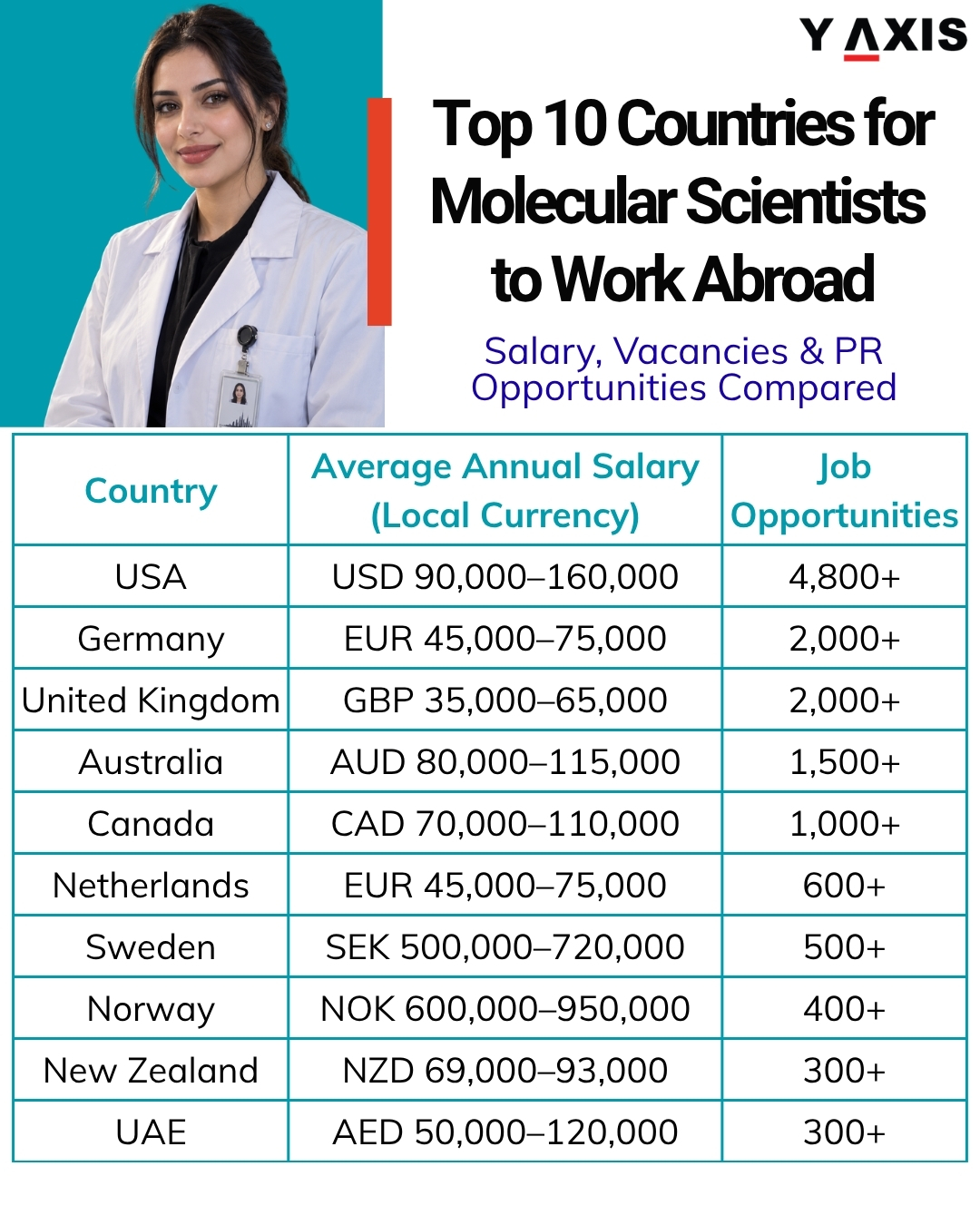
Top 10 Countries for Molecular Scientists to Work Abroad: Salary, Demand & PR Opportunities Compared
Top 10 Countries for Molecular Scientists to Work Abroad: Salary, Demand & PR Opportunities Compared
The top 10 countries for Molecular Scientists to work abroad include the USA, Germany, Canada, Australia, the UK, Ireland, Switzerland, the Netherlands, Singapore, and the UAE. These countries offer competitive salaries, advanced research facilities, work visa options, and permanent residency pathways.
The global biotechnology market is projected to reach approximately USD 3.88 trillion by 2030, driven by advances in genetic research, precision medicine, pharmaceutical innovation, and biotechnology applications. This expansion is creating more job opportunities in gene sequencing, drug development, molecular diagnostics, and DNA and RNA research, giving Molecular Scientists more options to build specialised careers abroad and pursue long-term residency.
*Want to work abroad? Sign up with Y-Axis Resume Marketing Services to find right job faster.
Benefits of Working Abroad as a Molecular Scientist
Working abroad as a Molecular Scientist offers competitive salaries, advanced laboratories, specialised roles, and international career growth. The global precision medicine market is projected to reach USD 254.7 billion by 2030, driven by advances in genomic testing, molecular diagnostics, biomarker research, and targeted drug development.
- Competitive Salaries: Earn attractive salaries in biotechnology and pharmaceuticals.
- Advanced Research: Access modern laboratories and molecular technologies.
- Specialised Roles: Work in genomics, sequencing, and drug discovery.
- Career Growth: Gain global experience and expand scientific expertise.
- Work Visa Options: Explore employment-based visa pathways.
- Permanent Residency: Pursue long-term settlement opportunities.
How to Choose the Right Country for Molecular Scientist Jobs Abroad?
Choosing the right country for Molecular Scientist jobs abroad depends on salary, job demand, research facilities, qualifications, and immigration options. Compare career opportunities in genomics, biotechnology, molecular diagnostics, and drug discovery, along with work visa requirements, living costs, and permanent residency pathways.
- Job Demand: Check opportunities in molecular biology, genomics, biotechnology, and pharmaceuticals.
- Salary: Compare average salaries with living costs and tax rates.
- Research Facilities: Look for countries with advanced laboratories and research institutions.
- Qualifications: Check degree, experience, and professional recognition requirements.
- Work Visa: Review visa eligibility, sponsorship requirements, and processing times.
- Permanent Residency: Compare skilled migration routes, eligibility criteria, and settlement timelines.
Top 10 Countries for Molecular Scientists to Work Abroad
The USA, Germany, Canada, Australia, the UK, and the UAE have growing demand for Molecular Scientists across biotechnology, pharmaceuticals, genomics, and molecular diagnostics. Many countries are offering specialised job roles such as Molecular Biologist, Genomics Scientist, Research Scientist, and Molecular Diagnostics Specialist, along with work visa and permanent residency pathways.
The global molecular diagnostics market is projected to reach USD 30.74 billion by 2030, growing at a CAGR of 9.6%. This expansion is increasing opportunities in DNA and RNA testing, gene sequencing, disease diagnosis, and precision medicine, supporting career growth for Molecular Scientists in international research and healthcare industries.
| Country | Average Annual Salary (Local Currency) | Estimated Molecular Scientist Job Opportunities |
|---|---|---|
| Canada | CAD 70,000–110,000 | 1,000+ |
| USA | USD 90,000–160,000 | 4,800+ |
| Germany | EUR 45,000–75,000 | 2,000+ |
| Australia | AUD 80,000–115,000 | 1,500+ |
| United Kingdom | GBP 35,000–65,000 | 2,000+ |
| Netherlands | EUR 45,000–75,000 | 600+ |
| Norway | NOK 600,000–950,000 | 400+ |
| Sweden | SEK 500,000–720,000 | 500+ |
| New Zealand | NZD 69,000–93,000 | 300+ |
| UAE | AED 50,000–120,000 | 300+ |
*Want to work abroad? Sign up with Y-Axis Resume Marketing Services to find right job faster.
Best Countries for Molecular Scientists to Work and Settle Abroad
The USA, Germany, Australia, Canada and the UK offer strong career opportunities for Molecular Scientists in molecular biology, biotechnology, pharmaceutical research, genomics and biomedical sciences. These countries provide competitive salaries, advanced research facilities and potential pathways to permanent residency.
The best country depends on your specialisation, qualifications, work experience and settlement goals. Comparing salary potential, job demand, research opportunities, visa requirements and permanent residency pathways can help you identify the right destination for your career and future abroad.
Molecular Scientist Jobs in the USA
The USA is a leading destination for Molecular Scientists seeking advanced research facilities, high-value career opportunities and scientific innovation. The country offers roles in molecular biology, genomics, drug discovery, biotechnology, genetic engineering and biomedical research. Employment for biochemists and biophysicists is projected to grow by 12% by 2035, driven by pharmaceutical development and genetic research. Molecular Scientists can work in biotechnology companies, pharmaceutical firms, universities and medical research institutions. The H-1B visa supports specialised employment, while EB-2 and EB-3 provide permanent residency pathways. The USA’s world-class research ecosystem enables Molecular Scientists to advance their expertise and build rewarding international careers.
| Factor | Details |
|---|---|
| Molecular Scientist Job Market & Job Vacancies for the Next Decade | The USA is expected to have more than 4,800 Molecular Scientist job opportunities over the next decade in molecular biology, genomics, gene therapy, molecular diagnostics, drug discovery and biotechnology research. |
| Investment in Biotechnology & Biomedical Research | The National Institutes of Health (NIH) receives more than USD 47 billion annually, supporting research in gene editing, DNA sequencing, cancer biology, precision medicine and therapeutic development. |
| Top Companies Hiring Molecular Scientists | Major employers include Pfizer, Moderna, Genentech, Amgen, Merck, Regeneron, Illumina and Thermo Fisher Scientific. Universities, NIH laboratories, biotechnology start-ups and contract research organisations also hire Molecular Scientists. |
| Top Cities for Molecular Scientist Jobs | Boston, San Diego, San Francisco, Washington DC, Raleigh-Durham and New York-New Jersey offer opportunities in genomics, pharmaceutical research, molecular diagnostics, cell biology and drug development. |
| In-Demand Molecular Scientist Roles & Skills | Key roles include Molecular Biologist, Genomics Scientist, Research Scientist, Cell Biology Scientist, Assay Development Scientist and Molecular Diagnostics Scientist. In-demand skills include PCR, qPCR, CRISPR, DNA/RNA sequencing, cell culture, molecular cloning and bioinformatics. |
| Work Visa Options | Molecular Scientists with a US job offer can pursue the H-1B visa for specialised scientific positions. Universities and research institutions may offer additional employment-based visa options. |
| Fast-Track Hiring Options | USCIS Premium Processing provides expedited processing for eligible petitions. Scientists with significant achievements in molecular research may also explore the O-1A visa. |
| PR / Long-Term Residence Opportunities | Molecular Scientists can pursue permanent residence through EB-2, EB-3, EB-2 National Interest Waiver and EB-1A pathways. Employer sponsorship, advanced research and scientific contributions can support different Green Card options. |
| Eligibility for Dependents | Molecular Scientists moving to the USA can generally include their spouse and unmarried children under 21 through H-4 or O-3 dependent status, depending on their visa category. |
| Benefits for Family Members | H-4 children can study in the USA, and certain H-4 spouses may obtain employment authorisation. O-3 dependents can study but generally cannot work. |
Molecular Scientist Jobs in Canada
Canada offers Molecular Scientists career opportunities in genomics, molecular diagnostics, biotechnology, drug discovery and biomedical research. The country’s expanding life sciences sector supports research in genetic testing, precision medicine, pharmaceutical development and advanced laboratory technologies. Molecular Scientists can work in pharmaceutical companies, universities, biotechnology firms, research institutes and diagnostic laboratories. Major research centres in Toronto, Montreal and Vancouver provide opportunities in molecular biology and genomic science. Express Entry and Provincial Nominee Programs offer permanent residency pathways for professionals who meet the relevant requirements. Canada’s research infrastructure, biotechnology investments and demand for specialised scientific expertise create opportunities for Molecular Scientists seeking international experience and long-term career development.
| Factor | Details |
|---|---|
| Molecular Scientist Job Market & Job Vacancies for the Next Decade | Canada is expected to have more than 1,000 Molecular Scientist job opportunities over the next decade in genomics, molecular diagnostics, gene therapy, drug discovery, vaccine development and biotechnology research. |
| Investment in Biotechnology & Biomedical Research | Canada is investing more than CAD 2.2 billion over seven years through its Biomanufacturing and Life Sciences Strategy. The investment supports genomics, vaccine development, therapeutics, molecular diagnostics and biomedical research. |
| Top Companies Hiring Molecular Scientists | Major employers include AbCellera, STEMCELL Technologies, BioVectra, Sanofi, Moderna, Pfizer, Roche and Thermo Fisher Scientific. Molecular Scientists work in genomics, cell biology, molecular testing, drug development and biomanufacturing. |
| Top Cities for Molecular Scientist Jobs | Toronto, Vancouver, Montreal, Ottawa, Calgary and Edmonton offer Molecular Scientist jobs in genomics, molecular diagnostics, pharmaceutical R&D, cell biology and biomedical research. |
| In-Demand Molecular Scientist Roles & Skills | Key roles include Molecular Biologist, Genomics Scientist, Research Scientist, Cell Biology Scientist, Molecular Diagnostics Scientist and Assay Development Scientist. Important skills include PCR, qPCR, CRISPR, DNA/RNA sequencing, cell culture, molecular cloning and bioinformatics. |
| Work Visa Options | Molecular Scientists with a Canadian job offer can apply for an employer-specific work permit. The employer provides the required employment documents and an LMIA when applicable. |
| Fast-Track Hiring Options | The Global Talent Stream offers faster work permit processing for Molecular Scientists working in genomics, molecular diagnostics, gene therapy and pharmaceutical research. |
| PR / Long-Term Residence Opportunities | Molecular Scientists can pursue permanent residence through Express Entry, including the Federal Skilled Worker Program and Canadian Experience Class. Provincial Nominee Programs provide additional routes through provincial nomination. |
| Eligibility for Dependents | Molecular Scientists moving to Canada can include their spouse or common-law partner and dependent children under 22 in their immigration application. |
| Benefits for Family Members | A spouse or common-law partner can apply for an open work permit under applicable immigration rules. Dependent children can study in Canada, while healthcare access follows provincial regulations and immigration status. |
*Want to Work in Canada? Let Y-Axis guide you through application process.
Molecular Scientist Jobs in Germany
Germany offers Molecular Scientists career opportunities in molecular diagnostics, genomics, drug discovery, cell biology and biopharmaceutical research. Its pharmaceutical, chemical and biotechnology industries support research in genetic testing, therapeutic development and advanced laboratory technologies. Biotechnology and nanotechnology are important innovation sectors, creating opportunities in research institutes, universities and private companies. The EU Blue Card and German work visa provide employment pathways for international scientific workers. Academic STEM occupations are included in the EU Blue Card shortage-occupation framework. Blue Card holders can obtain settlement after 21 months with B1 German or 27 months with A1 German. Germany’s advanced research infrastructure supports Molecular Scientists seeking international career growth.
| Factor | Details |
|---|---|
| Molecular Scientist Job Market & Job Vacancies for the Next Decade | Germany offers more than 2,000 estimated Molecular Scientist job opportunities over the next decade in molecular biology, genomics, drug discovery, gene therapy, molecular diagnostics and pharmaceutical research. |
| Investment in Biotechnology & Biomedical Research | Germany invests more than EUR 4.6 billion annually in medical biotechnology R&D. Pharmaceutical companies also invest more than EUR 10.7 billion in research and development, supporting genomics, gene therapy, molecular diagnostics and biopharmaceutical research. |
| Top Companies Hiring Molecular Scientists | Major employers include BioNTech, Bayer, Merck, Roche, Qiagen, Boehringer Ingelheim and Evotec. Universities, research institutes and biotechnology companies hire Molecular Scientists for genomic research, drug development and molecular testing. |
| Top Cities for Molecular Scientist Jobs | Berlin, Munich, Frankfurt, Hamburg and Heidelberg offer Molecular Scientist jobs in genomics, pharmaceutical research, molecular diagnostics, biotechnology and biomedical science. |
| In-Demand Molecular Scientist Roles & Skills | Key roles include Molecular Biologist, Research Scientist, Genomics Scientist, Cell Biology Scientist and Molecular Diagnostics Scientist. Important skills include PCR, CRISPR, DNA/RNA sequencing, cell culture, molecular cloning, protein analysis and bioinformatics. |
| Work Visa Options | Molecular Scientists can apply for the EU Blue Card with a recognised academic qualification and a German employment contract. A researcher residence permit supports employment at approved research institutions. |
| Fast-Track Hiring Options | Germany’s Accelerated Skilled Worker Procedure allows employers to begin the residence process with the foreigners authority before the scientist submits the visa application. |
| PR / Long-Term Residence Opportunities | EU Blue Card holders can apply for a settlement permit after 27 months with A1-level German or 21 months with B1-level German. Researchers have additional settlement routes under German residence rules. |
| Eligibility for Dependents | EU Blue Card holders can generally bring their spouse and minor children through family reunification. Family members receive residence permits to live in Germany. |
| Benefits for Family Members | Spouses can work in Germany without a separate work permit, while children can attend German schools. Family members can live with the Molecular Scientist during the residence period. |
Molecular Scientist Jobs in Australia
Australia offers Molecular Scientists opportunities in molecular biology, genomics, genetic engineering, biotechnology and pharmaceutical research. Employment across Australia is projected to grow 13.3% by 2035, supporting workforce expansion across scientific and technical industries. Molecular Scientists can pursue roles in pharmaceutical research, medical laboratories, universities, biotechnology companies and agricultural science. The Skills in Demand visa (subclass 482) provides an employment route, while the Employer Nomination Scheme visa (subclass 186) and skilled visas such as subclasses 189 and 190 offer permanent residency pathways. Australia’s research institutions and biotechnology investments create opportunities for Molecular Scientists to build long-term scientific careers.
| Factor | Details |
|---|---|
| Molecular Scientist Job Market & Job Vacancies for the Next Decade | Australia is expected to have more than 1,500 estimated Molecular Scientist job opportunities over the next decade in molecular biology, genomics, gene therapy, molecular diagnostics, drug discovery and biotechnology research. |
| Investment in Biotechnology & Biomedical Research | Australia is investing more than AUD 2 billion in medical research through the Medical Research Future Fund (MRFF), supporting genomics, precision medicine, cell therapies, vaccine development and molecular research. |
| Top Companies Hiring Molecular Scientists | Major employers include CSL, Cochlear, AstraZeneca, Pfizer, ResMed, Thermo Fisher Scientific, QIAGEN and Vaxxas. Universities, medical research institutes and biotechnology companies also hire Molecular Scientists. |
| Top Cities for Molecular Scientist Jobs | Melbourne, Sydney, Brisbane, Adelaide and Perth offer Molecular Scientist jobs in genomics, pharmaceutical research, molecular diagnostics, cell biology and biotechnology. Melbourne and Sydney have major biomedical research centres. |
| In-Demand Molecular Scientist Roles & Skills | Key roles include Molecular Biologist, Research Scientist, Genomics Scientist, Cell Biology Scientist, Molecular Diagnostics Scientist and Assay Development Scientist. Important skills include PCR, qPCR, CRISPR, DNA/RNA sequencing, cell culture, molecular cloning and bioinformatics. |
| Work Visa Options | The Skills in Demand visa (subclass 482) supports employer-sponsored employment in eligible occupations. Molecular Scientists can also explore skilled migration pathways based on their occupation, qualifications and experience. |
| Fast-Track Hiring Options | The Skills in Demand visa (subclass 482) provides an employer-sponsored route for Molecular Scientists. Scientists with internationally recognised achievements can explore the National Innovation visa (subclass 858). |
| PR / Long-Term Residence Opportunities | Molecular Scientists can explore Skilled Independent (subclass 189), Skilled Nominated (subclass 190) and Employer Nomination Scheme (subclass 186) visas. Regional workers can progress from subclass 491 to subclass 191 permanent residence. |
| Eligibility for Dependents | Skilled Australian visas can include a spouse or de facto partner and dependent children. Applicants must provide the required identity and relationship documents for their selected visa. |
| Benefits for Family Members | Family members can live in Australia with the Molecular Scientist. Partners can work according to their visa conditions, while dependent children can attend Australian schools. Medicare access depends on the visa and applicable rules. |
*Planning to Work in Australia? Let Y-Axis guide you through every step of the process.
Molecular Scientist Jobs in the UK
The UK offers Molecular Scientists opportunities in genomics, molecular diagnostics, pharmaceutical research, drug discovery and biomedical science. Government projections indicate approximately 66,000 additional jobs in priority life sciences occupations by 2035, supporting workforce expansion across research, biotechnology and pharmaceutical development. Molecular Scientists can work in universities, research institutions, pharmaceutical companies and biotechnology firms. The Skilled Worker visa provides a route to sponsored employment, while qualifying residence can lead to Indefinite Leave to Remain (ILR). The UK’s established life sciences clusters, research infrastructure and pharmaceutical industry create opportunities for Molecular Scientists seeking specialised expertise and long-term professional development.
| Factor | Details |
|---|---|
| Molecular Scientist Job Market & Job Vacancies for the Next Decade | The UK is expected to have more than 2,000 Molecular Scientist job opportunities over the next decade in genomics, molecular diagnostics, gene therapy, drug discovery, vaccine research and biotechnology. |
| Investment in Biotechnology & Biomedical Research | The UK has attracted more than £3 billion in life sciences investment, while the government’s sector plan includes more than £2 billion in funding. The investment supports genomics, molecular diagnostics, drug development and biomedical research. |
| Top Companies & Organisations Hiring Molecular Scientists | Major employers include AstraZeneca, GSK, Oxford Nanopore, BioNTech, Lonza, Charles River Laboratories, Thermo Fisher Scientific and Abcam. Universities, NHS laboratories and research institutes also hire Molecular Scientists. |
| Top Cities for Molecular Scientist Jobs | London, Cambridge, Oxford, Manchester, Edinburgh and Glasgow offer Molecular Scientist jobs in genomics, pharmaceutical R&D, molecular diagnostics, cell biology and biomedical research. |
| In-Demand Molecular Scientist Roles & Skills | Key roles include Molecular Biologist, Research Scientist, Genomics Scientist, Cell Biology Scientist, Molecular Diagnostics Scientist and Assay Development Scientist. Important skills include PCR, qPCR, CRISPR, DNA/RNA sequencing, cell culture, molecular cloning and bioinformatics. |
| Work Visa Options | The Skilled Worker visa allows Molecular Scientists to work for approved UK employers in eligible occupations. The visa requires an eligible job, sponsorship and the applicable salary. |
| Fast-Track Hiring Options | Priority visa processing can reduce processing times for eligible applications. Researchers with recognised achievements can also explore the Global Talent visa, which does not require employer sponsorship. |
| PR / Long-Term Residence Opportunities | The Skilled Worker route can lead to Indefinite Leave to Remain after five years of qualifying residence. Global Talent settlement is available after three or five years, depending on the applicant’s route. |
| Eligibility for Dependents | Skilled Worker and Global Talent visa holders can generally bring their partner and dependent children through the dependant visa route. |
| Benefits for Family Members | Dependant partners can generally work in the UK, while dependent children can attend UK schools. Family members can apply for settlement after meeting the relevant residence and visa requirements. |
* Want to Work in the UK? Let Y-Axis guide you through the steps.
Molecular Scientist Jobs in the Netherlands
The Netherlands offers Molecular Scientists career opportunities in genomics, molecular diagnostics, biotechnology, drug discovery and biopharmaceutical research. The country aims to increase research and development investment to 3% of GDP by 2030, supporting innovation in healthcare and biotechnology. Its biotechnology strategy also focuses on sector development through 2040, including medical, agricultural and industrial applications. Molecular Scientists can work in pharmaceutical companies, biotechnology firms, university medical centres and research institutes. The Highly Skilled Migrant permit and EU Blue Card provide work visa routes, while five years of continuous legal residence can support permanent residency. The Netherlands’ international research ecosystem offers opportunities for long-term scientific careers.
| Factor | Details |
|---|---|
| Molecular Scientist Job Market & Job Vacancies for the Next Decade | The Netherlands is expected to have more than 600 estimated Molecular Scientist job opportunities over the next decade in molecular biology, genomics, molecular diagnostics, drug discovery and biotechnology research. |
| Investment in Biotechnology & Biomedical Research | The Netherlands has more than EUR 1.27 billion allocated through National Growth Fund programmes for biotechnology research and commercialisation, supporting genomics, biomedical research, cellular therapies and pharmaceutical innovation. |
| Top Companies Hiring Molecular Scientists | Major employers include Genmab, Galapagos, QIAGEN, Thermo Fisher Scientific, Merck, Wageningen University & Research and Leiden University Medical Center. |
| Top Cities for Molecular Scientist Jobs | Amsterdam, Leiden, Utrecht, Rotterdam, Delft and Eindhoven offer jobs in genomics, molecular diagnostics, pharmaceutical research and biotechnology. |
| In-Demand Molecular Scientist Roles & Skills | Key roles include Molecular Biologist, Research Scientist, Genomics Scientist, Molecular Diagnostics Scientist and Cell Biology Scientist. Important skills include PCR, CRISPR, DNA/RNA sequencing, cell culture, molecular cloning and bioinformatics. |
| Work Visa Options | The Highly Skilled Migrant permit is a major route for scientists hired by an IND-recognised sponsor. The EU Blue Card is another option for qualified scientists who meet its salary and employment requirements. |
| Fast-Track Hiring Options | IND-recognised employers can submit Highly Skilled Migrant applications directly to the IND, streamlining residence processing. |
| PR / Long-Term Residence Opportunities | Molecular Scientists can apply for permanent residence after five consecutive years of lawful residence, with a valid permit, sufficient income and required civic integration. |
| Eligibility for Dependents | Residence-permit holders can generally bring their spouse or registered partner and dependent children through family reunification. |
| Benefits for Family Members | A Highly Skilled Migrant’s spouse or partner can generally work without a separate work permit. Dependent children can live in the Netherlands and attend Dutch schools. |
Molecular Scientist Jobs in Norway
Norway offers Molecular Scientists opportunities in molecular diagnostics, genomics, marine biotechnology, pharmaceutical research and aquaculture science. Molecular research supports genetic testing, disease investigation, therapeutic development and biotechnology applications across healthcare and marine industries. Molecular Scientists can pursue roles in universities, research institutes, pharmaceutical laboratories and biotechnology companies. Norway’s Skilled Worker residence permit provides an employment route for scientific workers with a relevant job offer. After three years of qualifying residence, applicants can pursue permanent residency under Norway’s settlement rules. The country’s strengths in medical research, marine science and biotechnology create opportunities for Molecular Scientists seeking international research experience and long-term career development.
| Factor | Details |
|---|---|
| Molecular Scientist Job Market & Job Vacancies for the Next Decade | Norway is expected to have more than 400 estimated Molecular Scientist job opportunities over the next decade in molecular biology, genomics, biotechnology, molecular diagnostics and pharmaceutical research. |
| Investment in Biotechnology & Biomedical Research | Norway allocates more than NOK 51 billion in public research funding, supporting biotechnology, biomedical research, genomics and pharmaceutical innovation. |
| Top Companies & Organisations Hiring Molecular Scientists | Major employers include Nykode Therapeutics, Thermo Fisher Scientific, GE HealthCare, Oslo University Hospital, the University of Oslo and NTNU, alongside biotechnology companies and research institutes. |
| Top Cities for Molecular Scientist Jobs | Oslo, Trondheim, Bergen, Tromsø and Stavanger offer Molecular Scientist jobs in biomedical research, biotechnology, genomics and molecular diagnostics. Oslo and Trondheim have major university and research centres. |
| In-Demand Molecular Scientist Roles & Skills | Key roles include Molecular Biologist, Research Scientist, Genomics Scientist, Molecular Diagnostics Scientist and Cell Biology Scientist. Important skills include PCR, CRISPR, DNA/RNA sequencing, cell culture, molecular cloning and bioinformatics. |
| Work Visa Options | Molecular Scientists with a relevant university degree and a Norwegian job offer can apply for a skilled-worker residence permit. The position must require their qualifications and offer standard Norwegian pay and working conditions. |
| Fast-Track Hiring Options | Norway’s Early Employment Start scheme can allow qualified Molecular Scientists to begin work before their residence application is decided when the required conditions are met. |
| PR / Long-Term Residence Opportunities | Molecular Scientists can generally apply for permanent residence after three years, with sufficient income, Norwegian language skills and a social-studies test, unless exempt. |
| Eligibility for Dependents | Skilled Molecular Scientists can generally bring their spouse, cohabitant and children through family immigration. |
| Benefits for Family Members | Spouses and cohabitants can generally work in Norway, while dependent children can live with the main visa holder and attend Norwegian schools. |
Molecular Scientist Jobs in Sweden
Sweden offers Molecular Scientists opportunities in molecular biology, genomics, molecular diagnostics, pharmaceutical research and biotechnology. Its life sciences sector supports research in precision medicine, genetic testing, drug development and advanced laboratory technologies. Molecular Scientists can work in pharmaceutical companies, biotechnology firms, universities and medical research institutions. Sweden’s work permit and EU Blue Card provide employment routes for international scientific workers. Qualifying employees can pursue permanent residency after meeting the applicable residence and employment conditions. Sweden’s research institutions, innovation-driven healthcare sector and biotechnology ecosystem create opportunities for Molecular Scientists to develop specialised skills and contribute to advanced scientific research.
| Factor | Details |
|---|---|
| Molecular Scientist Job Market & Job Vacancies for the Next Decade | Sweden is expected to have more than 500 estimated Molecular Scientist job opportunities over the next decade in molecular biology, genomics, biotechnology, molecular diagnostics and pharmaceutical research. |
| Investment in Biotechnology & Biomedical Research | Sweden invests more than SEK 40 billion annually in research and development, supporting biotechnology, genomics, molecular diagnostics, drug discovery and biomedical innovation. |
| Top Companies Hiring Molecular Scientists | Leading employers include AstraZeneca, Cytiva, Thermo Fisher Scientific, BioArctic, Sobi, Pfizer and Karolinska Institutet, alongside universities, hospitals and biotechnology companies. |
| Top Cities for Molecular Scientist Jobs | Stockholm, Uppsala, Gothenburg, Malmö and Lund offer Molecular Scientist jobs in biotechnology, pharmaceutical research, genomics and molecular diagnostics. |
| In-Demand Molecular Scientist Roles & Skills | Key roles include Molecular Biologist, Research Scientist, Genomics Scientist, Molecular Diagnostics Scientist and Cell Biology Scientist. Core skills include PCR, CRISPR, DNA/RNA sequencing, cell culture, molecular cloning and bioinformatics. |
| Work Visa Options | Molecular Scientists from outside the EU/EEA generally need a Swedish work permit based on an employment contract. Highly qualified scientists can also explore the EU Blue Card. |
| Fast-Track Hiring Options | Highly qualified Molecular Scientists may receive faster work permit processing, with decisions within 30 days when the application meets the required conditions. |
| PR / Long-Term Residence Opportunities | Molecular Scientists can apply for permanent residence after four years of work permits and employment during the past seven years, with sufficient financial support. |
| Eligibility for Dependents | Swedish work permit holders can generally bring their spouse, registered or cohabiting partner and unmarried children under 21. |
| Benefits for Family Members | Spouses and partners can work in Sweden, while dependent children can live with the main visa holder and attend Swedish schools under their residence status. |
Molecular Scientist Jobs in New Zealand
New Zealand offers Molecular Scientists career opportunities in molecular biology, genomics, biotechnology, genetic research and medical diagnostics. Molecular research supports healthcare, agricultural science, environmental applications and food technology. Molecular Scientists can work in universities, Crown research institutes, biotechnology companies, medical laboratories and agricultural research organisations. The Accredited Employer Work Visa (AEWV) provides an employment route, while the Skilled Migrant Category Resident Visa offers a pathway to residence. New Zealand’s growing bioeconomy and research sector support work involving genetic analysis, molecular testing and biotechnology innovation. These developments create opportunities for Molecular Scientists seeking international laboratory experience and long-term scientific careers.
| Factor | Details |
|---|---|
| Molecular Scientist Job Market & Job Vacancies for the Next Decade | New Zealand is expected to have more than 300 estimated Molecular Scientist job opportunities over the next decade in molecular biology, genomics, biotechnology, molecular diagnostics and biomedical research. |
| Investment in Biotechnology & Biomedical Research | New Zealand invests more than NZD 200 million annually in health research, supporting genomics, molecular diagnostics, biotechnology and medical innovation. |
| Top Companies & Organisations Hiring Molecular Scientists | Major employers include Fisher & Paykel Healthcare, Pacific Edge, ESR, AgResearch, Plant & Food Research, the University of Auckland and the University of Otago. |
| Top Cities for Molecular Scientist Jobs | Auckland, Wellington, Christchurch, Hamilton and Dunedin offer Molecular Scientist jobs in biotechnology, genomics, medical research and molecular diagnostics. |
| In-Demand Molecular Scientist Roles & Skills | Key roles include Molecular Biologist, Research Scientist, Genomics Scientist, Molecular Diagnostics Scientist and Laboratory Scientist. Important skills include PCR, qPCR, DNA/RNA sequencing, cell culture, molecular cloning and bioinformatics. |
| Work Visa Options | The Accredited Employer Work Visa (AEWV) is a major route for Molecular Scientists with a job offer from an accredited New Zealand employer. |
| Fast-Track Hiring Options | Molecular Scientists in listed Green List occupations, such as Medical Laboratory Scientist, may qualify for faster residence pathways. |
| PR / Long-Term Residence Opportunities | Molecular Scientists can explore Green List residence pathways and the Skilled Migrant Category Resident Visa. Medical Laboratory Scientists may qualify for the Straight to Residence pathway if they meet the listed requirements. |
| Eligibility for Dependents | Molecular Scientists on eligible work or resident visas can generally bring their partner and dependent children. |
| Benefits for Family Members | Partners may obtain a work visa, while dependent children can study in New Zealand under their visa conditions. Resident families have broader access to public services. |
Molecular Scientist Jobs in the UAE
The UAE offers Molecular Scientists growing opportunities in genomics, molecular diagnostics, pharmaceutical research, biotechnology and precision medicine. Abu Dhabi aims to create more than 20,000 life sciences jobs by 2035, supported by investments in healthcare innovation, genomic research and biopharmaceutical development. Molecular Scientists can pursue roles in diagnostic laboratories, pharmaceutical companies, biotechnology organisations, research institutions and medical technology centres. The UAE employment residence visa provides a work route, while the Golden Visa for scientists and researchers offers long-term residency opportunities for qualifying applicants. Investments in DNA sequencing, personalised medicine and advanced healthcare infrastructure create opportunities for Molecular Scientists seeking international career growth.
| Factor | Details |
|---|---|
| Molecular Scientist Job Market & Job Vacancies for the Next Decade | The UAE is expected to have more than 300 estimated Molecular Scientist job opportunities over the next decade in molecular biology, genomics, molecular diagnostics, biotechnology and pharmaceutical research. |
| Investment in Biotechnology & Biomedical Research | The UAE is investing in biotechnology, healthcare innovation and genomics, supporting molecular diagnostics, precision medicine, pharmaceutical research and advanced medical technologies. |
| Top Companies & Organisations Hiring Molecular Scientists | Major employers include G42, M42, PureHealth, Dubai Health, Abu Dhabi Public Health Centre, Thermo Fisher Scientific and university research centres. |
| Top Cities for Molecular Scientist Jobs | Abu Dhabi and Dubai offer the largest concentration of Molecular Scientist jobs in genomics, molecular diagnostics, biotechnology, healthcare research and pharmaceutical development. |
| In-Demand Molecular Scientist Roles & Skills | Key roles include Molecular Biologist, Research Scientist, Genomics Scientist, Molecular Diagnostics Scientist and Laboratory Scientist. Important skills include PCR, qPCR, DNA/RNA sequencing, molecular cloning, cell culture and bioinformatics. |
| Work Visa Options | Most Molecular Scientists work in the UAE through an employer-sponsored residence visa. The Green Residency offers five-year residence, while the Golden Residency provides five- or ten-year residence under designated categories. |
| Fast-Track Hiring Options | Molecular Scientists with recognised research achievements or specialised expertise can explore relevant Golden Residency categories, subject to approval and category requirements. |
| PR / Long-Term Residence Opportunities | The UAE does not offer conventional permanent residence through employment. Molecular Scientists can maintain long-term residence through Green Residency or Golden Residency. |
| Eligibility for Dependents | Green and Golden Residency holders can generally sponsor their spouse and children by submitting the required family-residence and relationship documents. |
| Benefits for Family Members | Sponsored family members can live and study in the UAE. Spouses can work after obtaining the required employment authorisation, while residence remains linked to the sponsor’s valid status. |
Job Outlook for Molecular Scientists Over the Next Decade
The job outlook for Molecular Scientists over the next decade is positive, with growing demand in genomics, molecular diagnostics, drug discovery, gene therapy and biotechnology research. Advances in DNA sequencing, CRISPR gene editing and personalised medicine are creating opportunities for molecular research and medical innovation. Countries such as the USA, Germany, Canada, Australia, the UK and the Netherlands are expanding their biotechnology and pharmaceutical sectors.
Molecular Scientists can pursue roles in drug development, genetic research, molecular testing and therapeutic innovation. The global biotechnology market is projected to reach approximately USD 6.34 trillion by 2035, supporting continued investment in research and creating opportunities across pharmaceutical companies, biotechnology firms, hospitals and research institutions.
*Want to work abroad? Sign up with Y-Axis Resume Marketing Services to find right job faster.
FAQs
Which countries hire the most Molecular Scientists abroad?
The USA, Germany, Canada, Australia, the UK, and the UAE hire the most Molecular Scientists, thanks to strong biotechnology, pharmaceutical, and genomics sectors. The USA leads with more than 4,800 estimated openings over the next decade, while the UK and Germany each offer around 2,000. Growth in drug discovery and molecular diagnostics continues to drive hiring across all six countries.
What is the average salary of a Molecular Scientist abroad?
Salaries range from USD 90,000 to 160,000 in the USA, EUR 45,000 to 75,000 in Germany, and AED 50,000 to 120,000 in the UAE. Pay depends on specialization, employer type, and experience level. The USA and Switzerland generally offer the highest gross compensation, while the UAE's tax-free packages make its salary bands especially competitive for relocating scientists.
USA or Canada for Molecular Scientists, which is the better choice?
The USA offers higher salaries and a larger job market, with over 4,800 estimated openings versus Canada's 1,000. Canada, however, provides a more accessible permanent residency route through Express Entry and Provincial Nominee Programs. Scientists prioritizing earning potential often favor the USA, while those focused on faster, clearer settlement typically lean toward Canada.
Which country offers the best PR pathway for Molecular Scientists?
Canada and Australia offer the clearest permanent residency pathways, through Express Entry, Provincial Nominee Programs, and skilled visa subclasses 189 and 190. Germany's EU Blue Card allows settlement within 21 to 27 months for qualified applicants. Each route rewards relevant qualifications and experience with defined timelines, helping scientists plan their long-term relocation with confidence.
Can Molecular Scientists get a work visa in the UAE?
Yes. Molecular Scientists can work in the UAE through an employer-sponsored residence visa, with Green Residency granting five years and Golden Residency offering five to ten years for qualifying candidates. Leading employers include G42, M42, and PureHealth. Abu Dhabi's plan to create 20,000 life sciences jobs by 2035 is expanding opportunities across genomics and biotechnology.
Does the UAE offer permanent residency for Molecular Scientists?
The UAE does not offer conventional permanent residency through employment, but Molecular Scientists can secure long-term residence through Green Residency or Golden Residency. Both options provide renewable residence periods of five to ten years, with family sponsorship included. Scientists with strong research credentials or notable achievements may qualify for extended Golden Residency categories.
What immigration options exist for Molecular Scientists moving abroad?
Molecular Scientists can pursue employer-sponsored work visas, points-based skilled migration, or specialized researcher permits, depending on the destination country. Canada and Australia offer points-based routes tied directly to permanent residency, while Germany and the Netherlands use the EU Blue Card. The UAE relies on employer sponsorship paired with Green or Golden Residency for long-term stays.
What does a career abroad look like for a Molecular Scientist?
A career abroad typically starts with a role at a pharmaceutical company, biotechnology firm, or research institution, often in genomics, drug discovery, or molecular diagnostics. Many scientists progress into senior research or specialist positions within a few years. International experience also builds a stronger foundation for eventual permanent residency, academic leadership, or industry consulting roles.
What qualifications do I need to work as a Molecular Scientist abroad?
Most employers require a bachelor's or master's degree in molecular biology, biochemistry, genetics, or a closely related field, along with hands-on laboratory experience. Specialized skills such as PCR, CRISPR, and DNA and RNA sequencing strengthen an application considerably. Countries like Germany and the Netherlands also require formal recognition of foreign academic qualifications before visa approval.
Which cities have the most Molecular Scientist job opportunities?
Boston, San Diego, and Cambridge lead globally, alongside Berlin, Toronto, and Abu Dhabi. These cities host major pharmaceutical companies, research universities, and biotechnology clusters that consistently hire Molecular Scientists. Abu Dhabi and Dubai are fast-growing UAE hubs, backed by significant government investment in genomics research and precision medicine infrastructure.
Is Molecular Scientist an in-demand job globally?
Yes, demand for Molecular Scientists is rising worldwide as the global biotechnology market heads toward USD 6.34 trillion by 2035. Growth in gene therapy, precision medicine, and molecular diagnostics is expanding roles across the USA, UAE, Canada, and Europe. Related occupations, such as biochemists in the USA, are projected to grow 12% by 2035.
What is the fastest way to get a Molecular Scientist visa?
Fast-track options differ by country: the USA offers USCIS Premium Processing, Germany runs an Accelerated Skilled Worker Procedure, and the UAE provides Golden Residency for scientists with recognized achievements. Norway's Early Employment Start scheme lets qualified scientists begin working before their residence application is finalized, cutting down waiting time considerably.
Can Molecular Scientists bring their family when working abroad?
Yes, most countries, including the UAE, USA, Canada, and Australia, allow Molecular Scientists to sponsor a spouse and dependent children under their work or residency visa. In the UAE, Green and Golden Residency holders can sponsor family members, who can then live, study, and often work, depending on their individual visa conditions.
Do Molecular Scientists need work experience to move abroad?
Work experience strengthens visa applications and job offers, though exact requirements vary by country and role. Entry-level positions may welcome recent graduates with solid laboratory skills, while specialized roles in genomics or drug discovery usually call for two or more years of research experience. Employer sponsorship remains the key requirement for most visas.
What are the top skills needed for Molecular Scientist jobs abroad?
In-demand skills include PCR, qPCR, CRISPR gene editing, DNA and RNA sequencing, cell culture, molecular cloning, and bioinformatics. These skills are consistently sought across the USA, UAE, Germany, Canada, and Australia. Scientists with added expertise in precision medicine and genomic testing tend to stand out in a competitive global job market.
How long does it take to get permanent residency as a Molecular Scientist?
Timelines vary widely: Norway and the Netherlands grant permanent residence after three to five years, Germany's EU Blue Card allows settlement in 21 to 27 months, and Sweden requires four years of work permits. The UAE instead offers long-term Golden Residency, which is often processed faster for qualifying scientists.
What is the job growth outlook for Molecular Scientists?
The outlook is strong, with the global molecular diagnostics market projected to reach USD 30.74 billion by 2030 at a 9.6% growth rate. Precision medicine is expected to hit USD 254.7 billion by 2030. This growth is generating steady demand for Molecular Scientists across the USA, UAE, Canada, Germany, and Australia.
Which country pays Molecular Scientists the highest salary?
The USA offers the highest salary range, from USD 90,000 to 160,000 annually, driven by strong pharmaceutical and biotechnology investment. Switzerland and Australia also rank highly for compensation. The UAE's tax-free income structure narrows this gap in practice, often delivering comparable take-home pay despite a lower headline salary range.
Which countries offer the best work-life balance for Molecular Scientists?
The Netherlands, Norway, and Sweden are known for favorable work-life balance alongside strong molecular science sectors. The UAE adds tax-free income and modern healthcare infrastructure to the mix, appealing to scientists focused on financial growth. The right fit ultimately depends on individual priorities around career pace, family life, and long-term settlement goals.
What is the future demand for Molecular Scientists in emerging markets like the UAE?
Demand in the UAE is set to grow steadily, supported by Abu Dhabi's target of 20,000 new life sciences jobs by 2035 and rising investment in genomics and personalized medicine. While smaller than the USA or UK markets today, the UAE's rapid healthcare innovation pipeline positions it as a strong long-term destination for Molecular Scientists.
Posted on September 17 2026

Top 10 Countries for Environmentalists to Work Abroad: Salary, Demand & PR Opportunities Compared
Top 10 Countries for Environmentalists to Work Abroad: Salary, Demand & PR Opportunities Compared
The top 10 countries for environmentalists to work abroad are Canada, Australia, Germany, the USA, the UK, the UAE, the Netherlands, Norway, New Zealand, and Singapore. These countries offer strong demand for environmental jobs, competitive salaries, work visa options, and permanent residency opportunities.
Demand for environmentalists is increasing in renewable energy, climate-change projects, waste management, water conservation, pollution control, biodiversity protection, and sustainable development. The World Economic Forum projects that climate-change adaptation could create 5 million net jobs globally by 2030, while climate-change mitigation could add another 3 million. Due to growing demand, environmentalists have strong job opportunities in international markets.
*Want to work abroad? Sign up with Y-Axis Resume Marketing Services to find right job faster.
Why Demand for Environmentalists Is Increasing Globally?
Environmentalists have strong career prospects as the global shift towards clean energy, climate action and sustainable resource management creates new jobs. The World Economic Forum expects Environmental Engineers and Renewable Energy Engineers to be among the 15 fastest-growing jobs through 2030.
- Clean energy: Assess solar, wind and hydrogen project impacts.
- Climate action: Support climate-risk, emissions and adaptation projects.
- Environmental compliance: Monitor pollution, waste and regulatory compliance.
- Water management: Manage water quality, conservation and treatment.
- Waste management: Support recycling, waste reduction and resource recovery.
- Sustainability: Help businesses reduce emissions, waste and resource use.
How to Choose the Right Country for Environmentalist Jobs Abroad?
The best country for environmentalist jobs abroad depends on salary, job demand, work visa options and PR opportunities. Check qualification requirements, employer sponsorship and demand for your specialisation in each country.
- Job demand: Check demand for environmental jobs and future hiring prospects.
- Salary: Compare average salaries with taxes and living costs.
- Work visa: Check visa routes, sponsorship requirements and work rights.
- PR options: Look for skilled migration and permanent residency pathways.
- Qualifications: Check whether your degree, certifications and experience are recognised.
- Career growth: Consider opportunities in clean energy, climate action, water, waste and sustainability.
Top 10 Countries for Environmentalists to Work Abroad
The UK, Canada, Australia, USA, Germany and UAE are among the top countries for environmentalists seeking jobs abroad, offering strong job demand, competitive salaries and opportunities for career growth. Environmental scientists, environmental consultants, environmental engineers and sustainability specialists can earn over AED 200,000 annually. The World Economic Forum expects the green transition to create 9.6 million net jobs globally by 2030, increasing demand for environmental and sustainability roles worldwide.
| Country | Average Annual Salary (Local Currency) | Estimated Environmentalist Job Opportunities |
|---|---|---|
| United Kingdom | GBP 40,000–65,000 | 12,000+ |
| Canada | CAD 76,000–115,000 | 6,600+ |
| Australia | AUD 100,000–135,000 | 5,000+ |
| USA | USD 82,000–140,000 | 73,000+ |
| Germany | EUR 50,000–75,000 | 15,000+ |
| UAE | AED 180,000–350,000 | 2,500+ |
| Netherlands | EUR 60,000–110,000 | 3,000+ |
| Norway | NOK 600,000–1,150,000 | 1,500+ |
| Singapore | SGD 65,000–115,000 | 1,000+ |
| New Zealand | NZD 80,000–130,000 | 1,000+ |
*Want to work abroad? Sign up with Y-Axis Resume Marketing Services to find right job faster.
Best Countries for Environmentalists to Work and Settle Abroad
Canada, Australia, Germany, the UK, and New Zealand are among the best destinations for Environmentalists seeking well-paid jobs and permanent residency. Environmentalists have strong opportunities in environmental consulting, climate change, conservation, pollution control, renewable energy, water management, and sustainability. Skilled migration and work visa programs provide pathways to permanent residency in several countries. Growing job demand, competitive salaries, and long-term settlement options make these destinations attractive for Environmentalists building careers abroad.
Environmentalist Jobs in the UK
The UK has a well-established market for environmental consultancy, ecology, conservation, climate policy, environmental assessment, water management and pollution control. Environmentalists work on net-zero projects, ecological surveys, environmental permits, contaminated land and impact assessments for consultancies, government bodies, engineering firms, energy companies and conservation organisations. A degree in environmental science, ecology or a related subject is common for specialist roles. The Skilled Worker visa provides an employer-sponsored route to UK employment, while Indefinite Leave to Remain (ILR) can provide permanent settlement after five years. The UK is an excellent choice for Environmentalists seeking careers in climate action, environmental regulation, infrastructure and ecological protection.
| Factor | Details |
|---|---|
| Environmentalist Job Market & Job Vacancies for the Next Decade | The UK could have more than 12,000 Environmentalist job opportunities over the next decade. Jobs span environmental consulting, ecology, conservation, climate policy, environmental assessment, water management and pollution control across government, consulting, engineering, energy and conservation. |
| Investment in Environmental Protection & Clean Energy | The UK is set to attract more than £100 billion in private clean-energy investment, supporting renewable energy, nature recovery, climate action and sustainable infrastructure. |
| Top Companies & Organisations Hiring Environmentalists | Major employers include AECOM, WSP, AtkinsRéalis, Jacobs, ERM, Arup, Ramboll, Ricardo and SLR Consulting, along with government environmental agencies. Jobs cover impact assessment, ecology, compliance, remediation, climate and sustainability. |
| Top Cities for Environmentalist Jobs | London, Birmingham, Manchester, Bristol, Edinburgh and Glasgow offer Environmentalist jobs across consulting, government, infrastructure, energy, research and conservation. London has particularly strong environmental consulting and policy activity. |
| In-Demand Environmentalist Roles & Skills | Key roles include Environmental Consultant, Environmental Scientist, Ecologist, Environmental Manager, Environmental Planner, Sustainability Consultant and Environmental Advisor. Skills include GIS, impact assessment, ecological surveys, environmental monitoring, data analysis and regulatory compliance. |
| Work Visa Options | The Skilled Worker visa is the main sponsored route for Environmentalists with a UK-approved employer, eligible occupation and required salary. The Global Talent visa is another option for Environmentalists with recognised achievements in science or research. |
| Fast-Track Hiring Options | Priority visa processing can shorten decisions for qualifying Skilled Worker applications. The Global Talent visa does not require employer sponsorship or a job offer. |
| PR / Long-Term Residence Opportunities | The Skilled Worker route can lead to Indefinite Leave to Remain after 5 years of continuous residence. The Global Talent route can lead to settlement after 3 or 5 years, depending on the route. |
| Eligibility for Dependents | Skilled Worker and Global Talent visa holders can bring a spouse or partner and dependent children through the UK dependant route. |
| Benefits for Family Members | Dependant partners can work in the UK, while dependent children can attend school. Family members can also build residence towards Indefinite Leave to Remain. |
* Want to Work in the UK? Let Y-Axis guide you through the steps.
Environmentalist Jobs in Canada
Canada gives Environmentalists career opportunities shaped by its forests, freshwater resources, mining, energy sector and protected natural areas. Jobs include environmental biologist, conservation scientist, environmental consultant, ecological specialist and resource-management specialist. Government departments, environmental consultancies, utilities, mining companies, energy firms and conservation organisations employ Environmentalists. Environmental biologists have stronger employment prospects in several Atlantic Provinces, Saskatchewan and the territories. A degree in environmental science, biology or a related field supports many environmental roles. Express Entry, Provincial Nominee Programs and employer-supported work permits provide routes to employment and permanent residence. Canada is particularly attractive for Environmentalists interested in conservation, natural resources, pollution control and environmental management.
| Factor | Details |
|---|---|
| Environmentalist Job Market & Job Vacancies for the Next Decade | Canada could have more than 6,600 Environmentalist job opportunities over the next decade, with jobs in environmental science, conservation, environmental consulting, pollution control, water management and ecological assessment across government, consulting firms, utilities, resource companies and conservation organisations. |
| Investment in Environmental Protection & Clean Energy | Canada is investing more than CAD 40 billion in clean-economy initiatives, supporting clean energy, climate action, emissions reduction, water management and environmental protection. |
| Top Companies Hiring Environmentalists | Major employers include WSP, GHD, Stantec, AECOM, Dillon Consulting, Hatch, SLR Consulting, SNC-Lavalin and Jacobs, along with government agencies, utilities, mining companies and conservation organisations. |
| Top Cities for Environmentalist Jobs | Toronto, Vancouver, Calgary, Edmonton, Ottawa and Montreal offer Environmentalist jobs across consulting, government, energy, mining, infrastructure, research and conservation. Vancouver has strong opportunities in environmental consulting, conservation and natural-resource management. |
| In-Demand Environmentalist Roles & Skills | Common roles include Environmental Scientist, Environmental Biologist, Environmental Consultant, Conservation Scientist, Ecologist, Environmental Specialist and Sustainability Specialist. Key skills include GIS, environmental assessment, ecological surveys, environmental monitoring, data analysis, remediation and regulatory compliance. |
| Work Visa Options | Environmentalists can use employer-specific work permits tied to a Canadian employer. The Global Talent Stream provides faster processing for designated high-skilled positions where the occupation and employer meet program requirements. |
| Fast-Track Hiring Options | The Global Talent Stream can speed up work-permit processing for qualifying Environmentalist positions. Employers submit the required applications before the Environmentalist applies for the work permit. |
| PR / Long-Term Residence Opportunities | Express Entry provides permanent residence routes through the Federal Skilled Worker Program and Canadian Experience Class. Provincial Nominee Programs (PNPs) provide another route for Environmentalists nominated by a province or territory. |
| Eligibility for Dependents | Canadian immigration applications can generally include a spouse or common-law partner and dependent children under 22. Family requirements vary by immigration program. |
| Benefits for Family Members | A spouse or common-law partner may obtain an open work permit, while dependent children can study in Canada. Provincial healthcare coverage depends on the province and immigration status. |
*Want to Work in Canada? Let Y-Axis guide you through application process.
Environmentalist Jobs in Australia
Australia’s environmental careers are closely connected to mining, energy, conservation and natural-resource management. Environmental Scientists work in environmental assessment, ecological monitoring, land rehabilitation, conservation, environmental consulting and sustainability across government, mining, energy, utilities and research. New South Wales, Victoria, Queensland and Western Australia have the largest shares of Environmental Scientist employment. Australia could face a shortfall of up to 3,000 Environmental Scientists by 2050 as the country moves towards net zero. A degree in environmental science or a related discipline supports many scientist roles. The Skills in Demand visa 482 and skilled visas 189, 190 and 491 provide work routes, while 186 provides an employer-sponsored permanent residence pathway.
| Factor | Details |
|---|---|
| Environmentalist Job Market & Job Vacancies for the Next Decade | Australia is expected to have more than 5,000 Environmentalist job opportunities over the next decade. Jobs cover environmental science, environmental consulting, conservation, ecological monitoring, pollution control and natural resource management. |
| Investment in Environmental Protection & Clean Energy | Australia has committed more than AUD 70 billion to decarbonisation, supporting investment in renewable energy, electricity transmission and clean industries and creating work in environmental assessment, biodiversity protection and environmental compliance. |
| Top Companies Hiring Environmentalists | Major employers include AECOM, WSP, GHD, Jacobs, Aurecon, ERM and Arcadis, along with mining companies, energy firms, government agencies and conservation organisations. Environmentalists work on impact assessments, ecological studies, compliance, rehabilitation and sustainability projects. |
| Top Cities for Environmentalist Jobs | Sydney, Melbourne, Brisbane, Perth and Adelaide offer Environmentalist jobs across consulting, government, mining, energy, infrastructure, research and conservation. Perth and Brisbane have strong opportunities linked to natural-resource and major infrastructure projects. |
| In-Demand Environmentalist Roles & Skills | Common roles include Environmental Scientist, Environmental Consultant, Environmental Research Scientist, Conservation Officer, Park Ranger and Environmental Specialist. Key skills include GIS, environmental impact assessment, ecological surveys, environmental monitoring, data analysis, pollution control and environmental reporting. |
| Work Visa Options | The Skills in Demand visa (subclass 482) allows Australian employers to sponsor Environmentalists in occupations listed under the skilled occupation framework. The Employer Nomination Scheme (subclass 186) provides an employer-sponsored permanent residence pathway. |
| Fast-Track Hiring Options | The subclass 482 Skills in Demand visa provides an employer-sponsored route for Environmentalists. Those with internationally recognised achievements and major contributions to environmental science may also consider the National Innovation visa (subclass 858). |
| PR / Long-Term Residence Opportunities | Permanent residence options include the Skilled Independent visa (subclass 189), Skilled Nominated visa (subclass 190) and Employer Nomination Scheme (subclass 186). Regional Environmentalists can use the subclass 491 pathway towards the permanent subclass 191 visa. |
| Eligibility for Dependents | Australian visas can allow an Environmentalist to include a spouse or de facto partner and dependent children. The visa determines which family members can be included and the documents required. |
| Benefits for Family Members | Family members can live in Australia with the main visa holder. Spouses or partners can work according to their visa conditions, while dependent children can attend Australian schools. Medicare access depends on visa status and Medicare rules. |
*Planning to Work in Australia? Let Y-Axis guide you through every step of the process.
Environmentalist Jobs in the USA
The USA provides a large employment market for Environmentalists in environmental science, pollution control, environmental compliance, conservation and environmental consulting. Environmental Scientists and Specialists work for state and local governments, federal agencies, scientific consulting firms, engineering companies and environmental organisations. A bachelor’s degree in environmental science, natural science or a related field is typically required. Employment for Environmental Scientists and Specialists is projected to grow 6% through 2035, creating continued demand for environmental roles. Employer sponsorship can provide an H-1B work route for qualifying environmental positions, while EB-2 and EB-3 provide employment-based permanent residence pathways. The USA offers Environmentalists careers in climate programmes, regulation, conservation and environmental risk assessment.
| Factor | Details |
|---|---|
| Environmentalist Job Market & Job Vacancies for the Next Decade | The USA offers Environmentalist jobs in environmental science, environmental consulting, pollution control, conservation, environmental compliance and environmental assessment. The occupation is projected to have around 73,000 openings over the next decade, with employment growth of 6% through 2035. |
| Investment in Environmental Protection & Clean Energy | The USA is projected to invest USD 330–740 billion by 2035 in additional power-system capacity for clean electricity, supporting jobs in environmental assessment, permitting, ecological protection and compliance. |
| Top Companies & Organisations Hiring Environmentalists | AECOM, Jacobs, Tetra Tech, WSP, ERM, Arcadis, Stantec and Ramboll, along with the EPA and state environmental agencies, hire Environmentalists for consulting, impact assessment, compliance, remediation and sustainability. |
| Top States for Environmentalist Jobs | California, Texas, New York, Florida, Washington and Massachusetts have large environmental job markets across government, consulting, energy, engineering, conservation and research. |
| In-Demand Environmentalist Roles & Skills | Key roles include Environmental Scientist, Environmental Consultant, Environmental Specialist, Ecologist, Environmental Planner and Sustainability Specialist. Important skills include GIS, environmental impact assessment, environmental sampling, data analysis, regulatory compliance, remediation and ecological surveys. |
| Education Requirements | Environmental Scientist and Specialist roles typically require a bachelor’s degree in environmental science, natural science or biology. Research and advanced environmental roles may require a master’s degree or professional certification. |
| Work Visa Options | The H-1B visa provides an employer-sponsored route for Environmentalists working in specialty occupations that require specialised knowledge and a qualifying degree or equivalent background. |
| Fast-Track Hiring Options | USCIS Premium Processing provides faster processing for eligible H-1B petitions. Environmentalists with extraordinary ability in science may also use the O-1A visa. |
| PR / Long-Term Residence Opportunities | EB-2 and EB-3 Green Cards provide employment-based routes to permanent residence. Environmentalists with advanced degrees or exceptional ability can also pursue the EB-2 National Interest Waiver, while EB-1A is an option for individuals with extraordinary ability. |
| Eligibility for Dependents | H-1B Environmentalists can bring a spouse and unmarried children under 21 on H-4 status. O-1A Environmentalists can bring the same family members under O-3 status. |
| Benefits for Family Members | H-4 children can study in the USA, and H-4 spouses may obtain work authorization under USCIS rules. O-3 dependents can study but cannot work. |
Environmentalist Jobs in Germany
Germany’s energy transition and industrial decarbonisation are creating environmental work across renewable energy, manufacturing, construction and infrastructure. Environmentalists can specialise in climate protection, environmental management, environmental consulting, water management, conservation and environmental analysis. Employment in environmental protection has grown by more than 30%, while companies and public authorities continue investing in emissions reduction and resource efficiency. Employers include government agencies, environmental consultancies, energy companies, research institutions and environmental organisations. The EU Blue Card, skilled-worker visa and Opportunity Card provide routes to environmental employment, with the Blue Card offering a pathway towards permanent settlement. Germany suits Environmentalists pursuing careers in industrial sustainability, clean energy and climate protection.
| Factor | Details |
|---|---|
| Environmentalist Job Market & Job Vacancies for the Next Decade | Germany's environmental sector is expected to generate more than 15,000 Environmentalist job opportunities over the next decade, covering climate protection, environmental consulting, water management, conservation, pollution control and environmental analysis. |
| Investment in Environmental Protection & Clean Energy | Germany is investing more than EUR 200 billion by 2030 in climate action and the energy transition, supporting jobs in renewable energy, emissions reduction, environmental assessment and sustainable infrastructure. |
| Top Companies Hiring Environmentalists | Major employers include Siemens, Bosch, E.ON, RWE, EnBW, Veolia, TÜV SÜD, WSP and ERM, along with government agencies, research institutions and environmental organisations. Jobs cover environmental consulting, compliance, climate projects and sustainability. |
| Top Cities for Environmentalist Jobs | Berlin, Munich, Hamburg, Frankfurt and Cologne offer Environmentalist jobs across consulting, government, energy, engineering, research and sustainability. Hamburg is particularly strong in water and marine environmental work. |
| In-Demand Environmentalist Roles & Skills | Common roles include Environmental Scientist, Environmental Consultant, Environmental Manager, Environmental Analyst, Ecologist, Sustainability Specialist and Environmental Engineer. Key skills include GIS, environmental impact assessment, monitoring, climate analysis, pollution control and regulatory compliance. |
| Work Visa Options | The EU Blue Card provides a route for Environmentalists with a recognised university qualification, German employment contract and required salary. The Skilled Worker visa is another route for Environmentalists with recognised qualifications and a job offer. |
| Fast-Track Hiring Options | Germany's Accelerated Skilled Worker Procedure lets an employer begin the residence process with the foreigners authority before the Environmentalist submits the visa application, speeding up the overseas hiring process. |
| PR / Long-Term Residence Opportunities | EU Blue Card holders can apply for a settlement permit after 27 months, or 21 months with B1-level German. Other residence routes also lead to permanent settlement after meeting residence, employment, language and integration requirements. |
| Eligibility for Dependents | EU Blue Card holders can bring a spouse and minor children through family reunification, with family members receiving German residence permits. |
| Benefits for Family Members | Spouses can work without a separate work permit, while children can attend German schools. Family members can live in Germany with the main visa holder. |
*Want to Work in Germany? Let Y-Axis guide you through every step of the process.
Environmentalist Jobs in the UAE
The UAE’s environmental employment market is closely linked to renewable energy, sustainable construction, water security and waste management. Environmentalists work on environmental impact assessments, environmental compliance, biodiversity protection, carbon reduction, waste treatment and water conservation. Common roles include environmental consultant, environmental specialist, environmental impact assessor, environmental compliance officer and sustainability specialist. Employers include government entities, engineering consultancies, energy companies, infrastructure developers and environmental service providers. UAE employers generally sponsor employment residence permits, while the Green Residence and Golden Residence provide longer-term residence options in designated categories. The UAE suits Environmentalists seeking work on renewable-energy developments, sustainable infrastructure, water management and environmental compliance projects.
| Factor | Details |
|---|---|
| Environmentalist Job Market & Job Vacancies for the Next Decade | The UAE is expected to have more than 2,500 Environmentalist job opportunities over the next decade, driven by work in environmental consulting, sustainability, waste management, water conservation, biodiversity, environmental assessment and climate action across Dubai, Abu Dhabi and other emirates. |
| Investment in Environmental Protection & Clean Energy | The UAE plans to invest AED 150–200 billion by 2030 in clean-energy projects, supporting renewable energy, emissions reduction, environmental assessment, biodiversity protection and sustainable infrastructure. |
| Top Companies Hiring Environmentalists | Major employers include AECOM, WSP, Jacobs, AtkinsRéalis, ERM, Veolia, Bee'ah, Masdar and Environment Agency – Abu Dhabi. Environmentalists work on environmental consulting, impact assessment, compliance, waste management, sustainability and conservation. |
| Top Cities for Environmentalist Jobs | Dubai and Abu Dhabi have the largest concentration of Environmentalist jobs. Dubai offers opportunities in sustainable infrastructure and waste management, while Abu Dhabi has strong demand across environmental regulation, conservation, energy and major development projects. |
| In-Demand Environmentalist Roles & Skills | Common roles include Environmental Consultant, Environmental Specialist, Environmental Scientist, Environmental Engineer, Sustainability Specialist, Environmental Auditor and Ecologist. Key skills include environmental impact assessment, GIS, environmental monitoring, waste management, biodiversity assessment, sustainability reporting and regulatory compliance. |
| Work Visa Options | Most Environmentalists work in the UAE through an employer-sponsored residence visa. The Green Residency provides renewable 5-year residence for skilled employees, while the Golden Residency offers 5- or 10-year residence under designated categories. |
| Fast-Track Hiring Options | The Golden Residency provides long-term residence without the usual employer-linked arrangement. Environmentalists with recognised expertise may use applicable specialist or talent categories under UAE residence rules. |
| PR / Long-Term Residence Opportunities | The UAE does not offer conventional permanent residence through employment. Environmentalists can maintain long-term residence through the 5-year Green Residency or 5- and 10-year Golden Residency. |
| Eligibility for Dependents | Green and Golden Residency holders can sponsor their spouse and children for UAE residence by completing the required family-residence application and providing relationship and residence documents. |
| Benefits for Family Members | Sponsored family members can live and study in the UAE. Spouses can work after obtaining the required employment authorisation, while family residence remains linked to the sponsor's valid residence status. |
Environmentalist Jobs in the Netherlands
The Netherlands offers Environmentalists strong career opportunities in water management, ecology and climate adaptation. Roles include water-quality specialist, ecologist, biodiversity specialist, environmental consultant, climate-adaptation specialist and sustainability specialist. Environmentalists work for water authorities, government agencies, engineering firms, environmental consultancies, energy companies and research organisations. Ecologists and nature managers are among the occupations facing labour shortages linked to the climate transition. The Highly Skilled Migrant permit and EU Blue Card provide routes into Dutch environmental employment, while permanent residence is generally possible after five years of qualifying residence. The Netherlands is especially attractive for Environmentalists focused on flood protection, water quality, ecosystem restoration and sustainable urban development.
| Factor | Details |
|---|---|
| Environmentalist Job Market & Job Vacancies for the Next Decade | The Netherlands could have more than 3,000 Environmentalist job opportunities over the next decade, with demand across water management, ecology, climate adaptation, biodiversity, environmental consulting and sustainability. |
| Investment in Environmental Protection & Clean Energy | The Netherlands is investing more than EUR 35 billion through 2030 in climate and energy measures, supporting renewable energy, climate adaptation, water management, biodiversity and emissions reduction. |
| Top Companies Hiring Environmentalists | Major employers include Arcadis, Royal HaskoningDHV, Witteveen+Bos, Sweco, Antea Group, TNO and Wageningen University & Research, along with water authorities, government agencies and energy companies. Jobs cover environmental consulting, water management, ecology, climate adaptation and sustainability. |
| Top Cities for Environmentalist Jobs | Amsterdam, Rotterdam, The Hague, Utrecht, Delft and Eindhoven offer Environmentalist jobs across consulting, government, water management, engineering, research and sustainability. Rotterdam has strong opportunities in water, environmental infrastructure and the energy transition. |
| In-Demand Environmentalist Roles & Skills | Common roles include Environmental Consultant, Environmental Scientist, Ecologist, Environmental Advisor, Sustainability Specialist, Water Management Specialist and Environmental Planner. Key skills include GIS, environmental impact assessment, ecological surveys, water management, climate analysis, data analysis and regulatory compliance. |
| Work Visa Options | The Highly Skilled Migrant permit is a key route for Environmentalists hired by an IND-recognised sponsor who meet the required salary. The EU Blue Card provides another route based on higher education, an employment contract and the required salary. |
| Fast-Track Hiring Options | The Highly Skilled Migrant route allows an IND-recognised employer to submit the residence application directly to the IND, simplifying the process for overseas Environmentalist hires. |
| PR / Long-Term Residence Opportunities | After 5 consecutive years of lawful residence, Environmentalists can apply for permanent residence by meeting Dutch requirements for residence history, income and civic integration. |
| Eligibility for Dependents | Dutch residence-permit holders can generally bring a spouse or registered partner and dependent children through family reunification. |
| Benefits for Family Members | A Highly Skilled Migrant's spouse or partner can generally work without a separate work permit, while dependent children can attend Dutch schools. |
Environmentalist Jobs in Norway
Norway connects environmental careers with nature protection, renewable energy and sustainable resource management. Environmentalists can work in environmental assessment, biodiversity, conservation, pollution control, water management and environmental consulting, while projects in offshore wind, hydrogen, battery production and electrification are expanding through 2035. Employers include government agencies, environmental consultancies, energy companies, engineering firms, research institutions and conservation organisations. A university degree in environmental science or another environmental discipline and a job offer from a Norwegian employer can provide a work residence permit. Environmentalists can generally apply for permanent residence after three years, with Norwegian language and social-studies requirements. Norway offers strong opportunities in marine ecosystems, clean energy and conservation.
| Factor | Details |
|---|---|
| Environmentalist Job Market & Job Vacancies for the Next Decade | Norway could have more than 1,500 Environmentalist job opportunities over the next decade, covering environmental assessment, biodiversity, conservation, pollution control, water management and environmental consulting. Offshore wind, hydrogen, batteries and electrification are also creating environmental work. |
| Investment in Environmental Protection & Clean Energy | Norway's Enova programme has a minimum annual funding level of NOK 7.958 billion, supporting clean energy, climate technology, emissions reduction and energy efficiency. |
| Top Companies & Organisations Hiring Environmentalists | Major employers include Equinor, Statkraft, DNV, Norconsult, Multiconsult, Ramboll and Sweco, along with government agencies, research institutions and conservation organisations. Jobs cover environmental assessment, biodiversity, climate projects, compliance and sustainability. |
| Top Cities for Environmentalist Jobs | Oslo, Bergen, Trondheim, Stavanger and Tromsø offer Environmentalist jobs across consulting, government, energy, research and conservation. Oslo is strong for environmental policy and consulting, while Stavanger has environmental work linked to energy projects. |
| In-Demand Environmentalist Roles & Skills | Common roles include Environmental Scientist, Environmental Consultant, Ecologist, Environmental Advisor, Conservation Specialist, Environmental Engineer and Sustainability Specialist. Key skills include GIS, environmental impact assessment, ecological surveys, environmental monitoring, climate analysis and regulatory compliance. |
| Work Visa Options | Environmentalists with a university degree and a job offer from a Norwegian employer can apply for a skilled-worker residence permit. The job must require their qualifications, with Norwegian pay and working conditions. |
| Fast-Track Hiring Options | Norway's Early Employment Start scheme can allow skilled Environmentalists to start work before their residence application is decided when the required conditions are met. |
| PR / Long-Term Residence Opportunities | Environmentalists can generally apply for permanent residence after three years. Requirements include income, A2-level Norwegian language skills and a social-studies test, unless exempt. |
| Eligibility for Dependents | Skilled Environmentalists can generally bring their spouse or cohabitant and children through family immigration. |
| Benefits for Family Members | Family members can live in Norway with the main applicant. Spouses or cohabitants can work, while children can attend Norwegian schools. |
Environmentalist Jobs in Singapore
Singapore’s environmental careers centre on urban sustainability, water security, waste management, carbon management and environmental compliance. The Green Plan 2030 targets 80% green buildings, at least 2 GWp of solar deployment and reduced waste sent to landfill, supporting jobs in environmental planning, energy, buildings and resource management. The Employment Pass Shortage Occupation List includes conservation scientist, environmental auditor, environmental compliance officer, environmental impact analyst, environmental management consultant and sustainability specialist. Environmentalists can use an Employment Pass for listed occupations, and Employment Pass holders can apply for permanent residence. Singapore is particularly suited to Environmentalists building careers in water management, carbon reduction, waste systems, environmental auditing and sustainable urban development.
| Factor | Details |
|---|---|
| Environmentalist Job Market & Job Vacancies for the Next Decade | Singapore's focus on urban sustainability, water security, waste management and climate action supports more than 1,000 Environmentalist job opportunities over the next decade. Jobs cover environmental compliance, impact assessment, conservation, carbon management, water management and sustainability. |
| Investment in Environmental Protection & Clean Energy | Singapore's Green Plan 2030 targets at least 2 GWp of solar deployment and 80% green buildings, driving investment in clean energy, sustainable buildings, resource efficiency and environmental management. |
| Top Companies Hiring Environmentalists | Major employers include AECOM, Jacobs, WSP, Ramboll, ERM, Veolia, Sembcorp and Surbana Jurong, along with government agencies and research institutions. Environmentalists work on environmental consulting, compliance, water management, sustainability and climate projects. |
| Top Cities for Environmentalist Jobs | Singapore is the country's main environmental employment hub. Jurong, Tuas, one-north and the city centre offer opportunities across environmental consulting, water management, clean energy, sustainability, research and industrial environmental management. |
| In-Demand Environmentalist Roles & Skills | Common roles include Environmental Consultant, Environmental Scientist, Environmental Auditor, Environmental Compliance Officer, Environmental Impact Analyst, Environmental Management Consultant and Sustainability Specialist. Key skills include environmental assessment, carbon management, GIS, water management, waste management, auditing and regulatory compliance. |
| Work Visa Options | The Employment Pass (EP) is the main work-pass route for Environmentalists in professional roles. The S Pass covers certain technical roles, with separate salary and employer requirements. |
| Fast-Track Hiring Options | The ONE Pass targets individuals with high salaries or outstanding achievements in areas such as research and innovation. Applications are generally processed within 4 weeks. |
| PR / Long-Term Residence Opportunities | Environmentalists holding an Employment Pass or S Pass can apply for Singapore Permanent Residence. Authorities consider employment, salary, qualifications, length of residence and economic contribution. |
| Eligibility for Dependents | Employment Pass holders earning the required salary can generally bring a legally married spouse and unmarried children under 21 on Dependant's Passes. |
| Benefits for Family Members | Dependant's Pass holders can live in Singapore. Spouses need the required work authorisation to work, while dependent children can attend Singapore schools subject to admission requirements. |
Environmentalist Jobs in New Zealand
New Zealand is particularly suited to Environmentalists interested in conservation, biodiversity, ecology and environmental science. Career options include environmental scientist, environmental research scientist, ecologist, conservation specialist, environmental technician and environmental engineer. The country’s 2030 emissions-reduction targets support work in clean energy, emissions management, biodiversity protection and sustainable resource use. Environmental Research Scientist and Environmental Engineer are Green List Tier 1 occupations with a Straight to Residence pathway. The Accredited Employer Work Visa (AEWV) also covers Organic Conservation Specialist, Environmental Technician and Environmental Engineering Technician. A degree in environmental science or environmental sustainability supports scientist-level roles. New Zealand combines conservation careers, climate work and direct residence pathways.
| Factor | Details |
|---|---|
| Environmentalist Job Market & Job Vacancies for the Next Decade | New Zealand could have more than 1,000 Environmentalist job opportunities over the next decade, with work across environmental science, ecology, conservation, environmental monitoring, climate policy, environmental compliance and sustainability. |
| Investment in Environmental Protection & Clean Energy | New Zealand is investing more than NZD 2.8 billion in climate and emissions-reduction initiatives, supporting clean energy, emissions management, biodiversity protection and sustainable resource use. |
| Top Companies & Organisations Hiring Environmentalists | Major employers include Tonkin + Taylor, Beca, WSP, GHD, Aurecon, Jacobs and Stantec, along with government agencies, councils, conservation organisations and research institutions. Jobs cover environmental consulting, ecological assessment, conservation, monitoring and sustainability. |
| Top Cities for Environmentalist Jobs | Auckland, Wellington, Christchurch, Hamilton and Dunedin offer Environmentalist jobs across consulting, government, conservation, infrastructure, research and environmental management. Wellington has strong opportunities in environmental policy and government work. |
| In-Demand Environmentalist Roles & Skills | Common roles include Environmental Scientist, Environmental Research Scientist, Ecologist, Conservation Scientist, Environmental Technician, Environmental Engineer and Environmental Consultant. Key skills include GIS, ecological surveys, environmental monitoring, impact assessment, data analysis, conservation and environmental reporting. |
| Work Visa Options | The Accredited Employer Work Visa (AEWV) provides a main route for Environmentalists with a job offer from an accredited New Zealand employer. Green List occupations can provide faster residence pathways for listed environmental roles. |
| Fast-Track Hiring Options | Environmental Research Scientist and Environmental Engineer are Green List Tier 1 occupations with a Straight to Residence pathway. The AEWV also provides an employer-sponsored route for other environmental roles. |
| PR / Long-Term Residence Opportunities | Green List Tier 1 Environmentalists can use the Straight to Residence pathway. Other Environmentalists can pursue residence through the Skilled Migrant Category Resident Visa and later apply for a Permanent Resident Visa. |
| Eligibility for Dependents | Environmentalists on eligible work or resident visas can generally bring their partner and dependent children. The available family visas depend on the main applicant's visa. |
| Benefits for Family Members | Partners may obtain a work visa, while dependent children can study in New Zealand under their visa conditions. Resident families have broader access to education and public services. |
Job Outlook for Environmentalists over the Next Decade
The job outlook for Environmentalists is positive worldwide, with the strongest demand coming from renewable energy, climate adaptation, water management, pollution control, biodiversity and environmental compliance. The World Economic Forum estimates that climate-change adaptation could create 5 million net jobs and climate-change mitigation another 3 million by 2030, while energy generation, storage and distribution could add 1 million jobs.
Environmental Engineers and Renewable Energy Engineers are among the 15 fastest-growing jobs globally. Over the next decade, Environmentalists will increasingly work on environmental impact assessments, renewable-energy permitting, carbon reduction, water quality, waste management, ecological restoration and environmental risk management. These areas provide clear career opportunities across government, consulting, energy, infrastructure and conservation.
*Want to work abroad? Sign up with Y-Axis Resume Marketing Services to find right job faster.
FAQs
Are Environmentalists in demand abroad?
Yes. Demand is increasing in renewable energy, environmental consulting, climate action, water management, pollution control, conservation, waste management and environmental compliance. Countries expanding clean-energy and climate programmes are creating more jobs for Environmental Scientists, Environmental Consultants, Ecologists, Environmental Engineers and Sustainability Specialists.
Which countries are best for Environmentalists to work abroad?
Canada, Australia, Germany, the UK, the USA, the UAE, the Netherlands, Norway, Singapore and New Zealand offer strong opportunities. The best choice depends on salary, environmental job demand, work visa options, permanent residence pathways and demand for your environmental specialisation.
What is the average salary for Environmentalists abroad?
Environmentalist salaries vary by country and specialisation. Among the countries compared, annual ranges include AED 180,000–350,000 in the UAE, USD 82,000–140,000 in the USA, AUD 100,000–135,000 in Australia and NOK 600,000–1,150,000 in Norway.
Which country pays Environmentalists the highest salary?
The UAE, Norway, Australia, Netherlands and USA offer some of the highest salary ranges in this comparison. Senior Environmental Engineers, Environmental Consultants, Environmental Managers and Sustainability Specialists generally command higher salaries than entry-level environmental roles.
How much do Environmental Scientists earn abroad?
Environmental Scientist salaries depend on experience, specialisation, location and employer. Typical annual ranges include USD 82,000–140,000 in the USA, CAD 76,000–115,000 in Canada, AUD 100,000–135,000 in Australia and GBP 40,000–65,000 in the UK.
Which Environmentalist jobs are most in demand?
Demand is strong for Environmental Scientists, Environmental Consultants, Environmental Engineers, Ecologists, Environmental Compliance Specialists, Conservation Scientists and Sustainability Specialists. Renewable energy, water management, pollution control, biodiversity, environmental assessment and climate projects are major areas of employment.
What qualifications are needed to work as an Environmentalist abroad?
Most Environmentalist positions require a bachelor's degree in environmental science, biology, ecology, natural science or environmental engineering. Specialist and research roles may require a master's degree, professional certification or technical experience in areas such as GIS, environmental assessment or environmental monitoring.
Can Environmentalists get jobs abroad without work experience?
Yes, entry-level Environmentalist jobs are available in environmental monitoring, laboratory work, ecological fieldwork, sustainability and environmental support. A relevant bachelor's degree, practical projects, internships, GIS skills and environmental certifications can strengthen applications for overseas entry-level positions.
Is Environmental Science a good career abroad?
Yes. Environmental Science offers career opportunities in climate action, renewable energy, conservation, water management, pollution control, environmental consulting and sustainability. Governments and businesses are increasing environmental programmes, creating opportunities for Environmental Scientists and other environmental specialists.
What skills are needed for Environmentalist jobs overseas?
Key skills include GIS, environmental impact assessment, ecological surveys, environmental monitoring, data analysis, pollution control, water management, environmental compliance and sustainability reporting. Knowledge of environmental legislation and experience with environmental assessment tools can improve job prospects.
Which countries offer the best opportunities for Environmental Scientists?
The USA, Germany, Canada, Australia and the UK have large Environmental Scientist job markets. The UAE, Netherlands, Norway, Singapore and New Zealand also offer opportunities in environmental consulting, climate action, conservation, water management, clean energy and sustainability.
How can I find Environmentalist jobs abroad?
Search government job portals, environmental consultancy websites, energy companies, engineering firms, conservation organisations and international recruitment platforms. Target job titles such as Environmental Scientist, Environmental Consultant, Environmental Engineer, Ecologist and Environmental Compliance Specialist.
What work visas are available for Environmentalists?
Visa options vary by country. Examples include the Skilled Worker visa in the UK, employer-sponsored visas in Australia, the EU Blue Card in Germany, H-1B in the USA, Highly Skilled Migrant permit in the Netherlands and Employment Pass in Singapore.
Can Environmentalists get permanent residency abroad?
Yes. Canada, Australia, Germany, the UK and New Zealand offer established pathways to permanent residence. Environmentalists can use skilled migration, employer sponsorship or occupation-specific residence routes, depending on their job, qualifications, work experience and immigration programme.
Which countries offer the best PR options for Environmentalists?
Canada, Australia, Germany and New Zealand offer strong permanent residence pathways for Environmentalists. The UK also provides settlement through routes such as Skilled Worker. New Zealand has particularly direct options for Environmental Research Scientists and Environmental Engineers through its Green List.
Can Environmentalists get a work visa without employer sponsorship?
Some routes do not require employer sponsorship. Examples include Australia's Skilled Independent visa, Germany's Opportunity Card and the UK's Global Talent visa for applicants who meet the specific requirements. Most standard work visas, however, are linked to an employer or job offer.
Can Environmentalists take their spouse and children abroad?
Yes. Many work and residence visas allow Environmentalists to bring a spouse or partner and dependent children. Family members may receive residence rights, work permission or education access depending on the immigration rules of the destination country.
Which countries are best for Environmentalists with a master's degree?
A master's degree can strengthen opportunities in Germany, Canada, Australia, the UK, the USA, the Netherlands and New Zealand. Advanced qualifications are particularly useful for Environmental Scientists, Environmental Engineers, researchers, environmental consultants and specialist climate or sustainability roles.
Can Environmentalists work in renewable energy and climate-related jobs?
Yes. Environmentalists work on environmental impact assessments, project permitting, biodiversity studies, emissions management, climate-risk analysis and environmental compliance for renewable-energy and infrastructure projects. Solar, wind, hydrogen, battery and electrification projects are expanding demand for environmental expertise.
What is the job outlook for Environmentalists over the next decade?
The outlook is positive globally. The World Economic Forum projects 8 million net jobs from climate-change adaptation and mitigation by 2030, while Environmental Engineers are among the 15 fastest-growing jobs globally. Demand will continue across clean energy, water, conservation, pollution control and environmental compliance.
Posted on September 11 2026
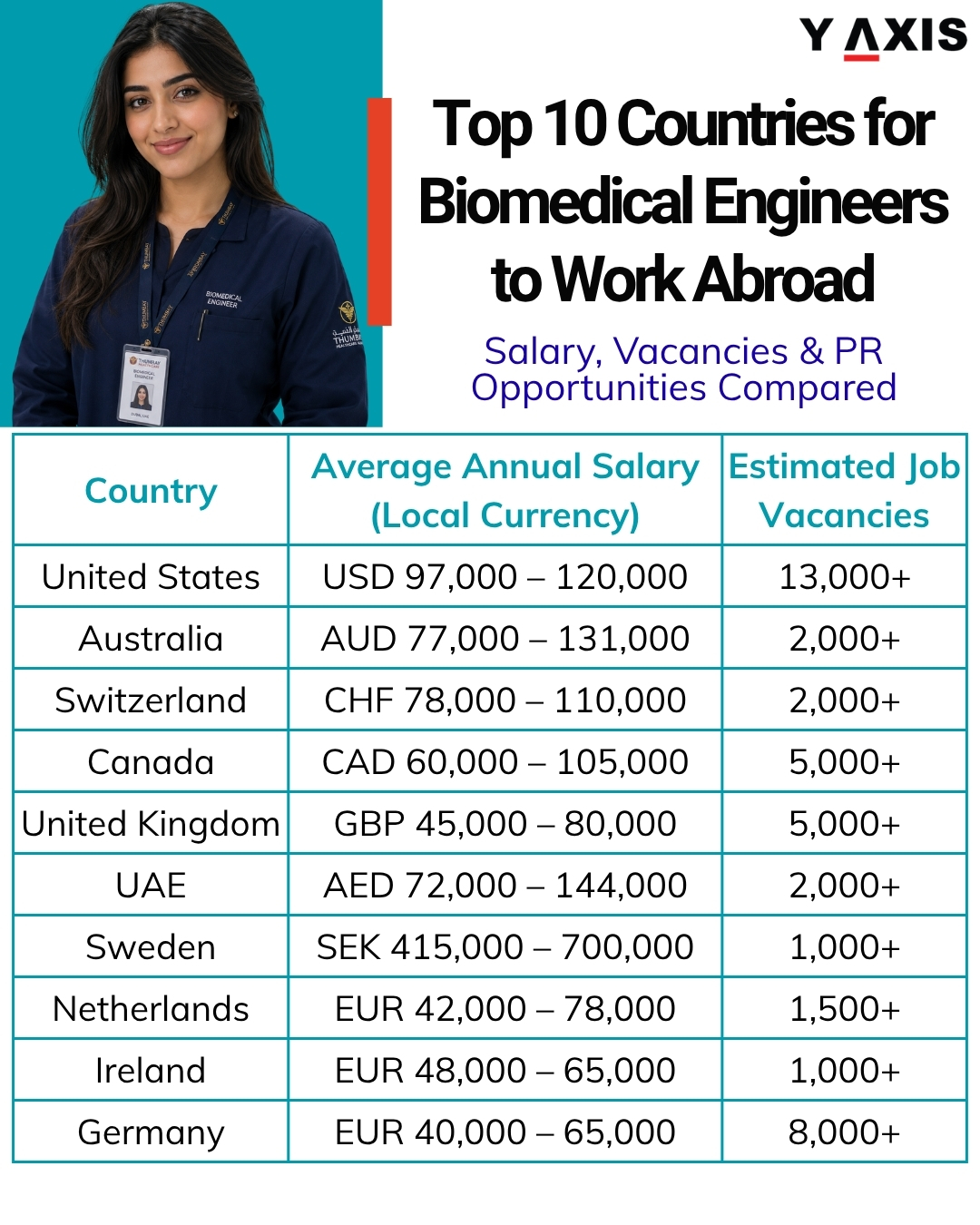
Top 10 Countries for Biomedical Engineers to Work Abroad: Salary, Demand & PR Opportunities Compared
Top 10 Countries for Biomedical Engineers to Work Abroad: Salary, Demand & PR Opportunities Compared
The top 10 countries for Biomedical Engineers to work abroad are the USA, Germany, Canada, Australia, the UK, Switzerland, Ireland, the Netherlands, the UAE, and Sweden. These countries offer competitive salaries, biomedical engineering jobs, established medical device industries, work visa options, and permanent residence pathways.
The global bioengineering market is projected to reach nearly USD 1.49 trillion by 2035, driven by rising demand for medical devices, diagnostic equipment, biomaterials, implants, prosthetics, wearable health devices, medical robotics, and biotechnology. This growth is increasing demand for Biomedical Engineers in medical device companies, hospitals, biotechnology and pharmaceutical companies, research laboratories, and healthcare technology firms, with opportunities across medical equipment, clinical engineering, medical devices, and biomedical research.
*Want to work abroad? Sign up with Y-Axis Resume Marketing Services to find right job faster.
Why Demand for Biomedical Engineers Is Increasing Globally?
Demand for Biomedical Engineers is rising with growing needs for medical devices, diagnostics, implants, patient monitoring, and rehabilitation technology. Ageing populations, chronic diseases, and advances in AI, robotics, imaging, wearables, and biotechnology are creating more opportunities worldwide.
- Medical Devices: Demand for diagnostic equipment, implants, prosthetics, and monitoring devices.
- Ageing Population: Greater need for mobility, rehabilitation, and monitoring technologies.
- Chronic Diseases: More diagnostic, treatment, and monitoring solutions.
- AI and Robotics: Growth in AI-assisted diagnostics and surgical robotics.
- Wearable Technology: Expansion of health tracking and remote monitoring devices.
- Biotechnology: Growth in biomaterials, tissue engineering, and regenerative medicine.
How to Choose the Right Country for Biomedical Engineering Jobs Abroad?
The right country depends on salary, job demand, medical technology industries, qualifications, work visa requirements, and permanent residence options. Biomedical Engineers should also consider the type of role they want, such as medical device engineering, clinical engineering, biomedical research, or healthcare technology.
- Salary: Compare average salaries with living costs and taxes.
- Job Demand: Check biomedical engineering vacancies and long-term job growth.
- Industry Strength: Look for strong medical device, biotechnology, pharmaceutical, and healthcare sectors.
- Qualifications: Check degree recognition, licensing, registration, and employer requirements.
- Work Visa: Compare skilled-worker and employer-sponsored visa options.
- PR Pathway: Check whether biomedical engineering roles can qualify for permanent residence.
Top 10 Countries for Biomedical Engineers to Work Abroad
The USA, Germany, Canada, Australia, and Switzerland are among the leading destinations for Biomedical Engineers, supported by established medical device, healthcare, biotechnology, and research industries. Ireland and the Netherlands also have strong medical technology and life sciences sectors. The global medical devices market is projected to reach around USD 1.2 trillion by 2035, supported by continued development in diagnostics, implants, monitoring equipment, surgical technologies, and digital healthcare. Biomedical Engineers can earn more than AED 200,000 and find strong job demand, work visa options, and permanent residence pathways across many destinations.
| Country | Average Annual Salary (Local Currency) | Estimated Biomedical Engineer Job Vacancies |
|---|---|---|
| United States | USD 97,000 – 120,000 | 13,000+ |
| Germany | EUR 40,000 – 65,000 | 8,000+ |
| Canada | CAD 60,000 – 105,000 | 5,000+ |
| Australia | AUD 77,000 – 131,000 | 2,000+ |
| United Kingdom | GBP 45,000 – 80,000 | 5,000+ |
| Sweden | SEK 415,000 – 700,000 | 1,000+ |
| Netherlands | EUR 42,000 – 78,000 | 1,500+ |
| UAE | AED 72,000 – 144,000 | 2,000+ |
| Ireland | EUR 48,000 – 65,000 | 1,000+ |
| Switzerland | CHF 78,000 – 110,000 | 2,000+ |
*Want to work abroad? Sign up with Y-Axis Resume Marketing Services to find right job faster.
Best Countries for Biomedical Engineers to Work and Settle Abroad
Canada, Australia, Germany, the UK, Ireland, and the USA are strong destinations for Biomedical Engineers looking to build an international career and settle abroad. These countries offer biomedical engineering jobs, competitive salaries, established MedTech industries, skilled-worker visa routes, and permanent residence options.
Demand is growing across medical devices, clinical engineering, medical imaging, prosthetics, biotechnology, research, and healthcare technology, creating opportunities for Biomedical Engineers to develop their careers and pursue long-term settlement.
Biomedical Engineer Jobs in the United States
The United States is a major market for Biomedical Engineers, with jobs in medical device design, clinical engineering, medical imaging, biomaterials, rehabilitation technology, robotics, and biomedical R&D. Employment for Bioengineers and Biomedical Engineers is projected to grow 5% by 2034, driven by demand for biomedical devices, procedures and healthcare technologies. A bachelor’s degree in biomedical engineering, bioengineering or a related engineering field is the standard entry qualification, while some research positions require graduate study. Biomedical Engineers can use the H-1B specialty-occupation route through a U.S. employer. EB-2 and EB-3 provide employment-based Green Card routes, supporting long-term careers in medical technology and healthcare.
| Factor | Details |
|---|---|
| Biomedical Engineer Job Market & Job Vacancies for the Next Decade | The U.S. is projected to have more than 13,000 Biomedical Engineer openings over the next decade, with employment growing 5% by 2034. Jobs span medical devices, imaging, healthcare equipment, biomaterials, rehabilitation technology, robotics and biomedical R&D. |
| Investment in Biomedical Engineering & Medical Technology | U.S. medtech companies spend more than USD 20 billion annually on R&D, with companies directing around 6–8% of revenue to research and development. Investment covers medical devices, diagnostics, imaging, surgical technology, robotics, wearable devices and biotechnology. |
| Top Companies Hiring Biomedical Engineers | Medtronic, Johnson & Johnson, Abbott, Boston Scientific, GE HealthCare, Stryker, Siemens Healthineers, Philips, Edwards Lifesciences and Baxter offer roles in medical devices, imaging, diagnostics, clinical engineering, product development and R&D. |
| Top Cities for Biomedical Engineer Jobs | Boston is a major biomedical and life-sciences hub. San Diego has strong medical-device and biotechnology activity, while Minneapolis, Houston, San Francisco, New York and Los Angeles offer opportunities across medical technology, healthcare and biomedical research. |
| In-Demand Biomedical Engineering Roles & Skills | Common roles include Biomedical Engineer, Clinical Engineer, Medical Device Engineer, R&D Engineer, Validation Engineer, Quality Engineer and Rehabilitation Engineer. Key skills include CAD, medical imaging, biomaterials, electronics, robotics, MATLAB, Python, testing and regulatory compliance. |
| Work Visa Options | The H-1B visa is a major route for Biomedical Engineer positions structured as specialty occupations. A bachelor's degree in biomedical engineering, bioengineering or a related engineering field is typically required, while specialised R&D roles may require advanced qualifications. |
| Fast-Track Hiring Options | USCIS Premium Processing provides expedited adjudication for eligible petitions, including qualifying H-1B cases. Biomedical Engineers with extraordinary ability in science may also consider the O-1A visa. |
| PR / Long-Term Residence Opportunities | Biomedical Engineers can pursue employment-based Green Cards through EB-2 and EB-3. Advanced-degree or research-focused Biomedical Engineers may also consider EB-2 National Interest Waiver, while EB-1A can apply to individuals with extraordinary ability. |
| Eligibility for Dependents | H-1B Biomedical Engineers can bring a spouse and unmarried children under 21 through H-4 status. O-1A holders can bring their spouse and unmarried children under 21 through O-3 status. |
| Benefits for Family Members | H-4 spouses can obtain employment authorization under specific USCIS rules, while H-4 children can study in the U.S. O-3 dependents can study, but O-3 status does not provide employment authorization. |
Biomedical Engineer Jobs in Germany
Germany is Europe’s largest medical-technology market, with more than 265,000 people employed in the MedTech industry. This creates opportunities for Biomedical Engineers in medical devices, diagnostics, imaging systems, prosthetics, orthopaedics, biomaterials, clinical technology, product development and R&D. A relevant university engineering qualification is the standard route into these positions. Biomedical Engineers can use the EU Blue Card for qualifying engineering employment. Germany also has one of the faster settlement routes in Europe: EU Blue Card holders can obtain a settlement permit after 27 months, reduced to 21 months with B1 German. This makes Germany particularly attractive for Biomedical Engineers seeking MedTech careers and permanent settlement.
| Factor | Details |
|---|---|
| Biomedical Engineer Job Market & Job Vacancies for the Next Decade | Germany has more than 8,000 estimated Biomedical Engineer vacancies across medical devices, diagnostics, imaging, prosthetics, biomaterials, clinical engineering and R&D, with roles in product development, testing, quality, manufacturing and healthcare technology. |
| Investment in Biomedical Engineering & Medical Technology | Germany's medical-technology market is valued at more than EUR 35 billion, with more than 265,000 sector employees. Investment spans medical devices, diagnostics, imaging, digital health, robotics and advanced healthcare technology. |
| Top Companies Hiring Biomedical Engineers | Siemens Healthineers, B. Braun, Dräger, Fresenius, Carl Zeiss Meditec, Ottobock, Philips, Roche and Medtronic have activities across medical devices, imaging, diagnostics, clinical technology and R&D. |
| Top Cities for Biomedical Engineer Jobs | Berlin has health-tech and research roles. Munich and Erlangen are strong in imaging and MedTech, while Hamburg and Dresden offer opportunities in healthcare technology, engineering and medical-device research. |
| In-Demand Biomedical Engineering Roles & Skills | Roles include Biomedical Engineer, Clinical Engineer, Medical Device Engineer, R&D Engineer, Quality Engineer, Validation Engineer and Regulatory Engineer. Key skills include CAD, medical imaging, biomaterials, robotics, MATLAB, Python, testing and regulatory compliance. |
| Work Visa Options | The EU Blue Card is a key route for Biomedical Engineers with a qualifying German employment contract, matching academic qualification and required salary. The Skilled Worker visa is another route for suitable engineering jobs. |
| Fast-Track Hiring Options | Employers can use Germany's Accelerated Skilled Worker Procedure to start the residence process through the local foreigners authority, helping speed up administrative steps for overseas Biomedical Engineers. |
| PR / Long-Term Residence Opportunities | EU Blue Card holders can obtain a settlement permit after 27 months, or 21 months with B1 German, when the other requirements are satisfied. |
| Eligibility for Dependents | EU Blue Card holders can bring their spouse and minor children through family reunification, allowing the family to relocate alongside the Biomedical Engineer. |
| Benefits for Family Members | A spouse can generally work without a separate work permit, while children can attend German schools. Family members can maintain residence through the family-reunification route. |
*Want to Work in Germany? Let Y-Axis guide you through application process.
Biomedical Engineer Jobs in Canada
Canada offers Biomedical Engineers careers in medical devices, clinical engineering, medical imaging, rehabilitation equipment, biomaterials, healthcare technology and biomedical research. Biomedical Engineers are classified under NOC 21399, with a bachelor’s degree in an appropriate engineering discipline generally required; master’s or doctoral qualifications may be needed for specialised positions. Engineering work involving professional approval can require registration with a provincial or territorial engineering association. Biomedical Engineers can enter Canada through employer-supported work permits and build Canadian experience in healthcare and MedTech. Express Entry and Provincial Nominee Programs provide major permanent-residence routes, giving Biomedical Engineers a practical pathway from engineering employment to long-term settlement.
| Factor | Details |
|---|---|
| Biomedical Engineer Job Market & Job Vacancies for the Next Decade | Canada is estimated to have more than 5,000 Biomedical Engineer vacancies over the next decade, with opportunities in medical-device design, clinical engineering, medical imaging, rehabilitation equipment, biomaterials and biomedical R&D. |
| Investment in Biomedical Engineering & Medical Technology | Canada's MedTech sector supports more than 88,000 full-time-equivalent jobs and generates about CAD 13.7 billion in gross value added. Annual MedTech R&D spending is estimated at CAD 404–445 million, covering medical devices, diagnostics, imaging, digital health and healthcare equipment. |
| Top Companies Hiring Biomedical Engineers | Medtronic, Abbott, Stryker, GE HealthCare, Siemens Healthineers, Boston Scientific, Zimmer Biomet, Baxter, Johnson & Johnson and STEMCELL Technologies offer opportunities in medical-device design, imaging, diagnostics, clinical equipment, product testing and biomedical R&D. |
| Top Cities for Biomedical Engineer Jobs | Toronto leads in hospitals, medical devices and biomedical research. Vancouver has biotechnology and MedTech opportunities, while Montreal is strong in biomedical research. Ottawa, Calgary and Edmonton also have clinical engineering and healthcare-technology roles. |
| In-Demand Biomedical Engineering Roles & Skills | Key roles include Clinical Engineer, Medical Device Engineer, Biomedical R&D Engineer, Rehabilitation Engineer, Quality Engineer and Validation Engineer. Employers seek CAD, biomechanics, biomaterials, medical imaging, electronics, MATLAB, Python, equipment testing and regulatory compliance skills. |
| Work Visa Options | Biomedical Engineers are classified under NOC 21399 – Other Professional Engineers, not elsewhere classified. An employer-specific work permit ties employment to the named employer. The Global Talent Stream applies when the position matches an occupation covered by the program. |
| Fast-Track Hiring Options | The Global Talent Stream offers expedited processing for qualifying high-skilled positions. The Canadian employer completes the required application and Labour Market Benefits Plan before the overseas worker submits the work-permit application. |
| PR / Long-Term Residence Opportunities | Express Entry provides permanent-residence routes through the Federal Skilled Worker Program and Canadian Experience Class. A Provincial Nominee Program provides another pathway through participating provinces and territories. |
| Eligibility for Dependents | A spouse or common-law partner and dependent children under 22 can generally be included as accompanying family members in a Canadian immigration application, subject to the requirements of the selected program. |
| Benefits for Family Members | A spouse or common-law partner may qualify for an open work permit, while dependent children can study in Canada. Healthcare coverage depends on the province or territory and the family's immigration status. |
*Want to Work in Canada? Let Y-Axis guide you through application process.
Biomedical Engineer Jobs in Australia
Australia recognises Biomedical Engineer as a distinct occupation under OSCA 243933, covering work involving biomedical systems, medical devices, prosthetics, diagnostic machines and health-monitoring technology. Around 1,400 people work in the occupation, with 87.7% working full time. Biomedical Engineers can work with hospitals, medical-device manufacturers, engineering companies, universities and research organisations, handling equipment development, testing, clinical technology and biomedical systems. A university-level engineering qualification is the standard educational pathway. Registration requirements depend on the state or territory and the type of engineering work. Australia also provides employer-sponsored and skilled migration pathways, including routes that lead to permanent residence, making it a strong option for Biomedical Engineers seeking healthcare-technology careers.
| Factor | Details |
|---|---|
| Biomedical Engineer Job Market & Job Vacancies for the Next Decade | Australia is expected to see more than 2,000 Biomedical Engineer opportunities over the next decade, with demand across medical devices, clinical engineering, medical imaging, prosthetics, rehabilitation technology, biomaterials and biomedical R&D. |
| Investment in Biomedical Engineering & Medical Technology | Australia's medical-technology sector is supported by more than AUD 7 billion in annual medical-device imports, alongside investment in medical devices, diagnostics, digital health, imaging, robotics and biotechnology. Biomedical Engineers contribute to device development, testing, manufacturing and healthcare innovation. |
| Top Companies Hiring Biomedical Engineers | ResMed, Cochlear, CSL, Medtronic, Siemens Healthineers, GE HealthCare, Philips, Johnson & Johnson, Stryker and Fisher & Paykel Healthcare offer opportunities across medical devices, diagnostics, respiratory technology, hearing implants, clinical equipment and biomedical R&D. |
| Top Cities for Biomedical Engineer Jobs | Sydney has strong medical-device, healthcare and biotechnology activity. Melbourne is a major biomedical research and MedTech centre, while Brisbane, Adelaide and Perth offer opportunities in medical technology, hospitals, research institutes and advanced manufacturing. |
| In-Demand Biomedical Engineering Roles & Skills | Roles include Biomedical Engineer, Clinical Engineer, Medical Device Engineer, Biomedical R&D Engineer, Rehabilitation Engineer, Quality Engineer and Validation Engineer. Employers seek medical-device design, CAD, biomaterials, biomechanics, medical imaging, electronics, MATLAB, Python, testing and regulatory skills. |
| Work Visa Options | The Skills in Demand visa (subclass 482) provides an employer-sponsored route for eligible occupations. Biomedical Engineer (ANZSCO 233913) is listed on Australia's skilled occupation framework, while the Employer Nomination Scheme (subclass 186) provides a permanent employer-sponsored pathway. |
| Fast-Track Hiring Options | The Skills in Demand visa (subclass 482) supports sponsored employment with an approved Australian employer. Biomedical Engineers with internationally recognised achievements may also consider the National Innovation visa (subclass 858), a permanent visa for exceptionally talented applicants. |
| PR / Long-Term Residence Opportunities | Biomedical Engineers can pursue skilled migration through subclass 189, state or territory nomination through subclass 190, or employer sponsorship through subclass 186. Regional employment through subclass 491 can lead to permanent residence through subclass 191. |
| Eligibility for Dependents | Spouses or de facto partners and dependent children can generally be included as family members on Australian visas that permit accompanying dependants. The specific visa determines which family members can be included and the evidence required. |
| Benefits for Family Members | Family members can live in Australia, and work rights for spouses or partners depend on the visa conditions. Dependent children can attend Australian schools, while healthcare access depends on the visa, Medicare eligibility and private health-insurance requirements. |
*Want to Work in Australia? Let Y-Axis guide you through application process.
Biomedical Engineer Jobs in the United Kingdom
The United Kingdom provides Biomedical Engineers with career opportunities in medical devices, clinical engineering, medical imaging, rehabilitation equipment, biomaterials, healthcare technology and biomedical R&D. Biomedical Engineers are specifically listed under SOC 2129, alongside Clinical Engineers and other engineering roles, and the occupation is included in the Skilled Worker system. Biomedical Engineers can work with the NHS, medical-device manufacturers, engineering companies, universities and research organisations in equipment development, clinical technology, testing and product design. A relevant engineering degree is normally required. The Skilled Worker route can lead to Indefinite Leave to Remain after five years, providing Biomedical Engineers with a clear pathway from UK employment to permanent settlement.
| Factor | Details |
|---|---|
| Biomedical Engineer Job Market & Job Vacancies for the Next Decade | The UK is projected to have more than 5,000 Biomedical Engineer opportunities over the next decade, with demand across medical devices, clinical engineering, medical imaging, prosthetics, rehabilitation technology, biomaterials and biomedical R&D. |
| Investment in Biomedical Engineering & Medical Technology | The UK life-sciences sector receives substantial investment in medical devices, diagnostics, biotechnology, digital health and healthcare technology. Government-backed life-sciences investment includes more than £2 billion for research and innovation, supporting medical-device development, diagnostics, imaging and biomedical research. |
| Top Companies Hiring Biomedical Engineers | Smith+Nephew, Renishaw, Siemens Healthineers, GE HealthCare, Philips, Medtronic, Johnson & Johnson, Stryker, Boston Scientific and AstraZeneca offer opportunities across medical devices, imaging, diagnostics, surgical technology, rehabilitation equipment and biomedical R&D. |
| Top Cities for Biomedical Engineer Jobs | London has major healthcare, medical-technology and research employers. Cambridge is a leading life-sciences cluster, while Oxford, Manchester, Edinburgh, Bristol and Birmingham offer opportunities across medical devices, biomedical research, healthcare technology and clinical engineering. |
| In-Demand Biomedical Engineering Roles & Skills | Roles include Biomedical Engineer, Clinical Engineer, Medical Device Engineer, R&D Engineer, Rehabilitation Engineer, Quality Engineer and Validation Engineer. Employers seek medical-device design, CAD, biomaterials, biomechanics, medical imaging, electronics, MATLAB, Python, testing and regulatory knowledge. |
| Work Visa Options | The Skilled Worker visa allows an approved UK employer to sponsor a qualifying Biomedical Engineer position. The Global Talent visa provides another route for researchers and specialists with recognised achievements or strong evidence of potential in science or engineering. |
| Fast-Track Hiring Options | The Skilled Worker visa offers priority processing services for eligible applications. The Global Talent visa does not require a job offer or employer sponsorship, providing Biomedical Engineers with an independent immigration route where the required endorsement or qualifying award is available. |
| PR / Long-Term Residence Opportunities | Skilled Worker visa holders can generally apply for Indefinite Leave to Remain after 5 years of qualifying residence. Global Talent holders can generally qualify for settlement after 3 or 5 years, depending on the route and circumstances. |
| Eligibility for Dependents | Skilled Worker and Global Talent visa holders can bring a spouse or partner and dependent children through the UK dependant route, subject to the immigration rules for the relevant visa. |
| Benefits for Family Members | Dependant partners can generally work in the UK, while dependent children can attend school. Family members can also pursue settlement when they complete the applicable qualifying residence period and meet the ILR requirements. |
* Want to Work in the UK? Let Y-Axis guide you through the steps.
Biomedical Engineer Jobs in Sweden
Sweden has a strong MedTech and healthcare-technology sector where Biomedical Engineers can work in medical devices, diagnostic systems, imaging technology, rehabilitation equipment, clinical engineering, digital health and biomedical R&D. Roles include product development, systems engineering, testing, medical technology and research across hospitals, technology companies, universities and MedTech organisations. A relevant university engineering qualification is the standard route into these careers. Biomedical Engineers from outside the EU generally use a Swedish work permit based on employment, with the job meeting Sweden’s salary and employment requirements. After four years of work-permit residence within the previous seven years, Biomedical Engineers can apply for permanent residence while continuing to meet the applicable requirements. Sweden is well suited to engineers interested in healthcare innovation and advanced medical technology.
| Factor | Details |
|---|---|
| Biomedical Engineer Job Market & Job Vacancies for the Next Decade | Sweden is expected to have more than 2,000 Biomedical Engineer opportunities over the next decade, with demand across medical devices, diagnostics, medical imaging, rehabilitation technology, biomaterials, life-science equipment and biomedical R&D. Stockholm, Gothenburg and Uppsala are major centres for MedTech and life-sciences employment. |
| Investment in Biomedical Engineering & Medical Technology | Sweden's medical-technology market is projected to reach around USD 3.5 billion, with investment focused on medical devices, diagnostics, imaging, digital health, surgical technology and healthcare equipment. Sweden also invests heavily in life-sciences R&D, supporting medical-device development, testing, clinical engineering and biomedical research. |
| Top Companies Hiring Biomedical Engineers | Getinge, Elekta, Sectra, Bactiguard, Mölnlycke Health Care, Thermo Fisher Scientific, GE HealthCare, Siemens Healthineers, AstraZeneca and Cytiva offer roles across medical devices, imaging, diagnostics, surgical technology, healthcare equipment and biomedical R&D. |
| Top Cities for Biomedical Engineer Jobs | Stockholm has Sweden's largest concentration of healthcare technology and life-sciences companies. Gothenburg is strong in medical devices and advanced engineering, while Uppsala has a major life-sciences cluster. Lund, Malmö and Linköping also offer biomedical research, MedTech and healthcare-technology roles. |
| In-Demand Biomedical Engineering Roles & Skills | Key roles include Biomedical Engineer, Medical Device Engineer, Clinical Engineer, R&D Engineer, Medical Imaging Engineer, Quality Engineer and Validation Engineer. Employers seek medical-device design, CAD, biomechanics, biomaterials, electronics, imaging, MATLAB, Python, testing and regulatory-compliance skills. |
| Work Visa Options | Biomedical Engineers from outside the EU/EEA generally need a Swedish work permit based on an employment offer from a Swedish employer. The employment must meet Sweden's salary, insurance and employment requirements. EU/EEA citizens can work in Sweden without a work permit. |
| Fast-Track Hiring Options | Sweden's highly qualified worker process can provide a decision within 30 days when the work-permit application is complete. The employer starts the application, followed by the Biomedical Engineer's application. |
| PR / Long-Term Residence Opportunities | A Biomedical Engineer can generally apply for permanent residence after 4 years of work and residence with a work permit during the previous 7 years, subject to Sweden's income, conduct and other permanent-residence requirements. |
| Eligibility for Dependents | A work-permit holder can bring a spouse, registered partner, cohabiting partner and children under 21 to Sweden. Family members apply for residence permits linked to the main applicant's work-based residence. |
| Benefits for Family Members | Family members with Swedish residence permits can live and work in Sweden, while children can attend Swedish schools. Healthcare access follows Sweden's residence and registration rules. |
Biomedical Engineer Jobs in the Netherlands
The Netherlands is a strong destination for Biomedical Engineers working in medical devices, medical imaging, biomaterials, clinical technology, rehabilitation systems, biotechnology and biomedical R&D. Its combination of hospitals, universities, technology companies and MedTech research centres supports careers in product development, systems engineering, testing, quality engineering and clinical technology. A relevant university engineering qualification is normally required. International Biomedical Engineers can use the Highly Skilled Migrant residence route through a recognised Dutch sponsor, while the EU Blue Card provides another work and residence option. After five years of lawful residence, Biomedical Engineers can apply for permanent residence under Dutch rules. The Netherlands combines a strong medical-technology ecosystem with a clear long-term residence pathway.
| Factor | Details |
|---|---|
| Biomedical Engineer Job Market & Job Vacancies for the Next Decade | The Netherlands is estimated to have more than 1,500 Biomedical Engineer opportunities over the next decade, with demand across medical devices, medical imaging, diagnostics, prosthetics, biomaterials, rehabilitation technology and biomedical R&D. |
| Investment in Biomedical Engineering & Medical Technology | The Dutch medical-technology sector is supported by more than EUR 6 billion in annual exports, with investment in medical devices, imaging systems, diagnostics, digital health, robotics and precision healthcare. This creates opportunities in product development, clinical technology, testing and biomedical R&D. |
| Top Companies Hiring Biomedical Engineers | Philips, ASML, Medtronic, Johnson & Johnson, Siemens Healthineers, Abbott, DEMCON, Technolution and Qserve offer opportunities across medical imaging, medical devices, healthcare technology, product development, testing, quality engineering and R&D. |
| Top Cities for Biomedical Engineer Jobs | Eindhoven is a major MedTech and high-tech engineering hub, while Amsterdam has healthcare technology and research opportunities. Leiden is strong in life sciences, and Utrecht, Rotterdam and Delft offer roles across hospitals, universities, medical technology and engineering. |
| In-Demand Biomedical Engineering Roles & Skills | Roles include Biomedical Engineer, Clinical Engineer, Medical Device Engineer, R&D Engineer, Medical Imaging Engineer, Quality Engineer and Validation Engineer. Employers seek medical-device design, CAD, biomaterials, biomechanics, imaging, electronics, MATLAB, Python, testing and regulatory knowledge. |
| Work Visa Options | Biomedical Engineers can use the Highly Skilled Migrant residence permit when hired by a recognised Dutch sponsor and paid the required salary. The EU Blue Card is another route for highly qualified employment with the required salary, qualifications and employment contract. |
| Fast-Track Hiring Options | Under the Highly Skilled Migrant route, a recognised Dutch sponsor submits the residence application directly to the IND, providing a streamlined employer-led process for overseas Biomedical Engineers. |
| PR / Long-Term Residence Opportunities | After 5 consecutive years of lawful residence, Biomedical Engineers can apply for permanent residence if they satisfy Dutch requirements covering residence history, income, civic integration and other conditions. |
| Eligibility for Dependents | A Biomedical Engineer holding a qualifying Dutch residence permit can bring a spouse or registered partner and dependent children through family-reunification rules, subject to the requirements for the specific residence status. |
| Benefits for Family Members | A spouse or partner of a Highly Skilled Migrant can generally work in the Netherlands without a separate work permit, while dependent children can attend Dutch schools. |
Biomedical Engineer Jobs in the UAE
The UAE has a growing market for Biomedical Engineers in hospital biomedical engineering, clinical engineering, medical-device maintenance, healthcare technology and medical equipment management. Hospital Biomedical Engineers work with patient monitors, ventilators, defibrillators, imaging systems and laboratory equipment, handling installation, testing, maintenance, calibration and technical support. A bachelor’s degree in Biomedical Engineering is commonly required, while hospital roles can also involve professional registration and relevant experience. Biomedical Engineers normally work through an employer-sponsored UAE residence visa. The UAE Golden Visa provides a longer residence option through approved specialised-profession categories. Dubai and Abu Dhabi offer major healthcare networks, hospitals and medical-device companies, giving Biomedical Engineers opportunities to build careers in clinical equipment and healthcare technology.
| Factor | Details |
|---|---|
| Biomedical Engineer Job Market & Job Vacancies for the Next Decade | The UAE is expected to have more than 2,000 Biomedical Engineer opportunities over the next decade, driven by investment in advanced hospitals, medical devices, diagnostic equipment, medical imaging, rehabilitation technology and healthcare innovation. Dubai and Abu Dhabi offer the strongest concentration of healthcare and medical-technology employers. |
| Investment in Biomedical Engineering & Medical Technology | The UAE is investing heavily in healthcare technology, with the Dubai Economic Agenda D33 targeting AED 100 billion in annual economic value from digital transformation. Investment in smart hospitals, AI-enabled diagnostics, medical devices, robotics and digital healthcare is creating opportunities in biomedical equipment and healthcare engineering. |
| Top Companies Hiring Biomedical Engineers | Siemens Healthineers, GE HealthCare, Philips, Medtronic, Johnson & Johnson, Abbott, Stryker, Al Zahrawi Medical, PureHealth and Burjeel Holdings offer opportunities across medical devices, diagnostic systems, clinical equipment, imaging, healthcare technology and biomedical engineering services. |
| Top Cities for Biomedical Engineer Jobs | Dubai has a large private healthcare and medical-device market, while Abu Dhabi has major hospitals, healthcare groups and government-backed healthcare projects. Sharjah also has opportunities through hospitals, universities, research institutions and healthcare-technology companies. |
| In-Demand Biomedical Engineering Roles & Skills | Common roles include Biomedical Engineer, Clinical Engineer, Medical Equipment Engineer, Biomedical Service Engineer, Medical Device Engineer, R&D Engineer and Healthcare Technology Engineer. Employers seek medical equipment maintenance, calibration, imaging systems, electronics, equipment testing, troubleshooting, CAD, MATLAB and regulatory compliance skills. |
| Work Visa Options | Most Biomedical Engineers work in the UAE through an employer-sponsored employment residence visa. The Green Residency provides a renewable 5-year residence for eligible skilled employees, while the Golden Residency offers 5- or 10-year residence under designated categories. |
| Fast-Track Hiring Options | The Golden Residency provides long-term residence without the usual employer-linked residence arrangement. Biomedical and healthcare technology specialists can use relevant specialist, talent or other designated categories when they satisfy the specific UAE requirements. |
| PR / Long-Term Residence Opportunities | The UAE does not offer conventional permanent residence or citizenship through employment. Biomedical Engineers can instead maintain long-term residence through the 5-year Green Residency or 5- and 10-year Golden Residency, depending on the applicable category. |
| Eligibility for Dependents | Green and Golden Residency holders can sponsor their spouse and children for UAE residence. The sponsor must complete the required family-residence application and provide documents such as passports, relationship proof and valid UAE residence documentation. |
| Benefits for Family Members | Sponsored family members can live and study in the UAE. A spouse can work after obtaining the required employment authorisation, while family residence remains linked to the sponsor's valid residence status and the applicable family-sponsorship rules. |
Biomedical Engineer Jobs in Ireland
Ireland is one of Europe’s major MedTech centres, with 32,000 MedTech employees across more than 300 companies. This creates strong demand for Biomedical Engineers in medical-device design, product development, manufacturing, process engineering, validation, quality engineering, regulatory affairs and R&D. Ireland’s medical-device industry has a particularly strong manufacturing and product-development base, with established clusters supporting research and innovation. A relevant engineering degree is the standard route into Biomedical Engineer roles. The Critical Skills Employment Permit provides an important work route for listed engineering occupations. After two years on a Critical Skills Employment Permit, workers can generally move to Stamp 4, giving Biomedical Engineers greater freedom to work without an employment permit and plan long-term careers in Ireland.
| Factor | Details |
|---|---|
| Biomedical Engineer Job Market & Job Vacancies for the Next Decade | Ireland is estimated to have more than 1,000 Biomedical Engineer opportunities over the next decade, with demand across medical devices, diagnostics, medical imaging, biomaterials, prosthetics, clinical engineering and biomedical R&D. |
| Investment in Biomedical Engineering & Medical Technology | Ireland's MedTech sector has more than 300 companies and 45,000+ employees, with 75% of the workforce engaged in R&D. Recent investment includes €75 million from Boston Scientific for R&D in Galway and more than €10 million from Siemens Healthineers for a diagnostics R&D centre in Swords. |
| Top Companies Hiring Biomedical Engineers | Medtronic, Boston Scientific, Abbott, Stryker, Johnson & Johnson MedTech, Zimmer Biomet, Cook Medical, Edwards Lifesciences, Siemens Healthineers and BD offer opportunities across medical-device design, diagnostics, clinical equipment, manufacturing, quality, validation and R&D. |
| Top Cities for Biomedical Engineer Jobs | Galway is Ireland's major MedTech hub, with strong medical-device R&D and manufacturing. Dublin has healthcare technology and multinational operations, while Cork, Limerick, Swords and Athlone have established medical-device, diagnostics and life-sciences activity. |
| In-Demand Biomedical Engineering Roles & Skills | Key roles include Biomedical Engineer, Medical Device Engineer, R&D Engineer, Quality Engineer, Validation Engineer, Manufacturing Engineer and Clinical Engineer. Employers seek CAD, biomaterials, medical imaging, biomechanics, electronics, MATLAB, Python, process validation, quality systems and medical-device regulations. |
| Work Visa Options | The Critical Skills Employment Permit is a major route for relevant engineering positions listed on Ireland's Critical Skills Occupations List. The General Employment Permit covers other qualifying Biomedical Engineering roles that meet its occupation and salary requirements. |
| Fast-Track Hiring Options | The Critical Skills Employment Permit does not require a Labour Market Needs Test and provides a direct route for listed occupations. After the required employment period, holders can move to Stamp 4, allowing employment without another employment permit. |
| PR / Long-Term Residence Opportunities | Critical Skills Employment Permit holders can generally move to Stamp 4 after 2 years. Long-Term Residency can be pursued after 60 months of qualifying legal residence, subject to Ireland's residence and immigration requirements. |
| Eligibility for Dependents | Critical Skills Employment Permit holders can bring their spouse or civil partner, de facto partner and dependent children through Ireland's family-reunification process, subject to the applicable immigration requirements. |
| Benefits for Family Members | A spouse or civil partner of a Critical Skills Employment Permit holder can generally receive Stamp 1G, allowing employment without a separate employment permit. Dependent children can live and attend school in Ireland. |
Biomedical Engineer Jobs in Switzerland
Switzerland is a high-value destination for Biomedical Engineers, particularly in medical devices, diagnostics, pharmaceuticals, medical imaging, biomaterials, clinical engineering, product development, regulatory affairs and biomedical R&D. Its strong connection between MedTech, pharmaceuticals and life-sciences research creates specialised engineering roles with medical-device companies, pharmaceutical businesses, hospitals, universities and research institutions. A relevant university engineering qualification is normally required. Biomedical Engineers from outside the EU/EFTA generally need an employer-sponsored Swiss work permit, with employers following Swiss labour-market rules and third-country worker quotas. Switzerland also provides a C settlement permit as a permanent-residence route, generally after 10 years of residence. For Biomedical Engineers, Switzerland combines advanced medical technology, research-intensive work and a strong long-term European career environment.
| Factor | Details |
|---|---|
| Biomedical Engineer Job Market & Job Vacancies for the Next Decade | Switzerland is expected to have more than 2,000 Biomedical Engineer opportunities over the next decade, with demand across medical devices, diagnostics, medical imaging, robotics, biomaterials, prosthetics and biomedical R&D. The country's strong pharmaceutical, MedTech and precision-engineering sectors create opportunities in product development and clinical technology. |
| Investment in Biomedical Engineering & Medical Technology | Switzerland's MedTech industry generates around CHF 23 billion in annual revenue and invests heavily in medical devices, diagnostics, surgical technology, imaging and digital health. Companies and research institutions continue investing in precision engineering, robotics, AI-enabled healthcare and advanced medical-device development. |
| Top Companies Hiring Biomedical Engineers | Roche, Novartis, Medtronic, Johnson & Johnson MedTech, Zimmer Biomet, Stryker, Siemens Healthineers, ABB, Ypsomed and Sonova offer opportunities across medical devices, diagnostics, imaging, surgical systems, rehabilitation technology and biomedical R&D. |
| Top Cities for Biomedical Engineer Jobs | Zurich has strong healthcare, engineering and research activity. Basel is a major life-sciences centre, while Lausanne and Geneva have biomedical research and medical-technology employers. Bern and Neuchâtel also offer opportunities in medical devices, precision engineering and healthcare technology. |
| In-Demand Biomedical Engineering Roles & Skills | Roles include Biomedical Engineer, Medical Device Engineer, Clinical Engineer, R&D Engineer, Medical Imaging Engineer, Quality Engineer and Validation Engineer. Employers seek CAD, biomechanics, biomaterials, medical imaging, electronics, robotics, MATLAB, Python, device testing and regulatory compliance skills. |
| Work Visa Options | Non-EU/EFTA Biomedical Engineers generally need an L or B residence permit and employer-sponsored work authorisation. Switzerland gives priority to Swiss and EU/EFTA workers, while employers must demonstrate the required conditions for hiring workers from outside the EU/EFTA. |
| Fast-Track Hiring Options | Switzerland has no dedicated fast-track visa for Biomedical Engineers. EU/EFTA nationals have simpler employment procedures, while third-country nationals require employer-sponsored authorisation through the applicable Swiss work-permit process. |
| PR / Long-Term Residence Opportunities | The C permit provides permanent settlement in Switzerland. The standard route generally requires 10 years of residence, while nationals covered by specific agreements can obtain settlement after 5 years. |
| Eligibility for Dependents | A Biomedical Engineer holding a qualifying Swiss residence permit can apply for family reunification for a spouse and children, subject to the permit type, accommodation, financial and other Swiss requirements. |
| Benefits for Family Members | Family members admitted through reunification can live in Switzerland. Work rights depend on their residence status; spouses and children joining C-permit holders generally have broader access to the Swiss labour market. |
*Want to Work in Switzerland? Let Y-Axis guide you through application process.
Job Outlook for Biomedical Engineers over the Next Decade
The job outlook for Biomedical Engineers is positive over the next decade, with demand supported by advances in medical devices, diagnostic systems, medical imaging, rehabilitation technology, robotics, prosthetics and digital healthcare. The U.S. Bureau of Labor Statistics projects 5% employment growth for bioengineers and Biomedical Engineers by 2034, with around 1,300 job openings each year. Demand will also grow as healthcare providers adopt wearable sensors, remote patient monitoring, AI-enabled diagnostics and advanced medical equipment.
Biomedical Engineers with skills in medical-device design, biomaterials, biomechanics, imaging, electronics, software, clinical engineering and regulatory compliance can access opportunities across MedTech companies, hospitals, research institutions, pharmaceutical companies and medical-device manufacturers.
*Want to work abroad? Sign up with Y-Axis Resume Marketing Services to find right job faster.
FAQs
Which country is best for Biomedical Engineers to work abroad?
The United States, Germany, Switzerland, Australia, Canada and the UK are strong destinations for Biomedical Engineers. The U.S. has a large medical-device and biomedical research industry, Germany has a major MedTech manufacturing base, and Switzerland has strong medical-device and life-sciences companies. Australia and Canada combine Biomedical Engineering jobs with skilled migration pathways.
Which country has the highest demand for Biomedical Engineers?
The United States has one of the largest Biomedical Engineering employment markets. U.S. employment of bioengineers and Biomedical Engineers is projected to grow 5% through 2034, with about 1,300 openings each year. Medical-device development, clinical engineering, medical imaging, rehabilitation equipment and biomedical R&D are major areas of employment.
What is the salary of a Biomedical Engineer abroad?
Biomedical Engineer salaries depend on experience, location and specialisation. Switzerland, the United States, Australia and Germany offer strong salary potential. Senior engineers working in medical-device R&D, medical imaging, robotics, clinical engineering and regulatory engineering generally earn more than entry-level Biomedical Engineers.
What qualifications are required to work as a Biomedical Engineer abroad?
A bachelor’s degree in Biomedical Engineering is accepted for many international positions. Employers may also consider electrical, mechanical or electronics engineering degrees for medical-device roles. A master’s degree or PhD is more relevant for advanced R&D, tissue engineering, biomaterials, medical imaging and research positions.
Which Biomedical Engineer jobs are in demand abroad?
The main roles include Biomedical Engineer, Clinical Engineer, Medical Device Engineer, Biomedical R&D Engineer, Medical Imaging Engineer, Rehabilitation Engineer, Quality Engineer and Validation Engineer. Medical-device design, diagnostics, imaging systems, prosthetics, rehabilitation equipment and clinical technology are important employment areas.
What skills do Biomedical Engineers need to work abroad?
Important technical skills include CAD, biomechanics, biomaterials, medical imaging, electronics, MATLAB, Python, robotics, medical-device testing and validation. Knowledge of ISO 13485, quality management systems, risk management and medical-device regulations is particularly useful for product-development and quality roles.
Can Biomedical Engineers get jobs abroad with a bachelor’s degree?
Yes. A bachelor’s degree can lead to positions in medical-device design, manufacturing, quality engineering, validation, clinical equipment and technical support. Advanced R&D positions in areas such as tissue engineering, biomaterials and medical imaging may require a master’s degree or PhD.
Can Biomedical Engineers work in hospitals abroad?
Yes. Hospitals employ Biomedical Engineers in clinical engineering and medical-equipment management. Typical responsibilities include evaluating, testing and maintaining patient monitors, ventilators, infusion pumps, imaging equipment and other clinical systems, as well as managing equipment safety and technology procurement.
Can Biomedical Engineers work for medical-device companies abroad?
Yes. Medical-device companies hire Biomedical Engineers for product development, R&D, prototyping, testing, validation, manufacturing, quality assurance and regulatory affairs. Major employers include Medtronic, Abbott, Stryker, Boston Scientific, Siemens Healthineers and GE HealthCare.
Which countries offer work visas for Biomedical Engineers?
Major destinations have dedicated skilled-worker routes. Examples include the H-1B in the U.S., employer-specific work permits in Canada, subclass 482 in Australia, Skilled Worker visa in the UK, EU Blue Card in Germany, Critical Skills Employment Permit in Ireland and Highly Skilled Migrant permit in the Netherlands.
Can Biomedical Engineers get permanent residence abroad?
Yes. Canada, Australia, Germany, the UK, Ireland, the Netherlands and Sweden offer permanent-residence or long-term residence pathways. Requirements vary by route and can include years of residence, employment, salary, language ability, qualifications and immigration history.
Which country is best for Biomedical Engineers seeking PR?
Canada and Australia are strong options for Biomedical Engineers seeking permanent residence. Canada offers Express Entry and Provincial Nominee Programs, while Australia has skilled and employer-sponsored routes including subclasses 189, 190 and 186, with regional pathways that can lead to permanent residence through subclass 191.
Is Biomedical Engineering a good career abroad?
Yes. Biomedical Engineers can build careers in medical devices, clinical engineering, diagnostics, medical imaging, prosthetics, rehabilitation technology, robotics and biomedical R&D. Demand is supported by healthcare technology development, advanced medical equipment, wearable devices, remote monitoring and AI-enabled diagnostic systems.
Which companies hire Biomedical Engineers abroad?
Major employers include Medtronic, Abbott, Stryker, Boston Scientific, Siemens Healthineers, GE HealthCare, Philips, Johnson & Johnson MedTech, Zimmer Biomet, Roche and Baxter. Their engineering roles cover medical devices, imaging, diagnostics, surgical equipment, clinical technology, R&D, quality and validation.
Which cities have the most Biomedical Engineer jobs?
Major Biomedical Engineering hubs include Boston and San Francisco in the U.S.; Toronto and Vancouver in Canada; Sydney and Melbourne in Australia; London and Cambridge in the UK; Munich and Berlin in Germany; Eindhoven in the Netherlands; Galway and Dublin in Ireland; Zurich and Basel in Switzerland; and Stockholm and Gothenburg in Sweden.
Can Biomedical Engineers work in medical imaging abroad?
Yes. Biomedical Engineers work with MRI, CT, ultrasound, X-ray and other diagnostic imaging technologies. Roles include imaging-system development, equipment testing, image-processing technology, hardware integration and clinical technology support. Medical-imaging companies, hospitals, universities and research institutes employ engineers in this field.
Can Biomedical Engineers work in prosthetics and rehabilitation technology?
Yes. Biomedical Engineers design and develop prosthetic limbs, orthotic devices, rehabilitation robots, assistive equipment and wearable sensors. These roles require knowledge of biomechanics, materials, electronics, sensors, mechanical design and control systems and are available in MedTech companies, hospitals and research institutions.
Do Biomedical Engineers need professional licensing abroad?
Not for every job. Many private medical-device, R&D, quality and manufacturing positions do not require professional engineering registration. Clinical engineering and regulated engineering positions can have additional requirements, so the licensing rules should be checked for the specific country and position.
What is the future of Biomedical Engineer jobs through 2034?
The outlook is positive, particularly in medical-device development, medical imaging, robotics, wearable health technology, rehabilitation equipment, diagnostics and biomedical R&D. In the U.S., employment is projected to grow 5% through 2034. Biomedical Engineers with software, electronics, robotics, imaging or regulatory skills can access a wider range of future roles.
Posted on August 28 2026
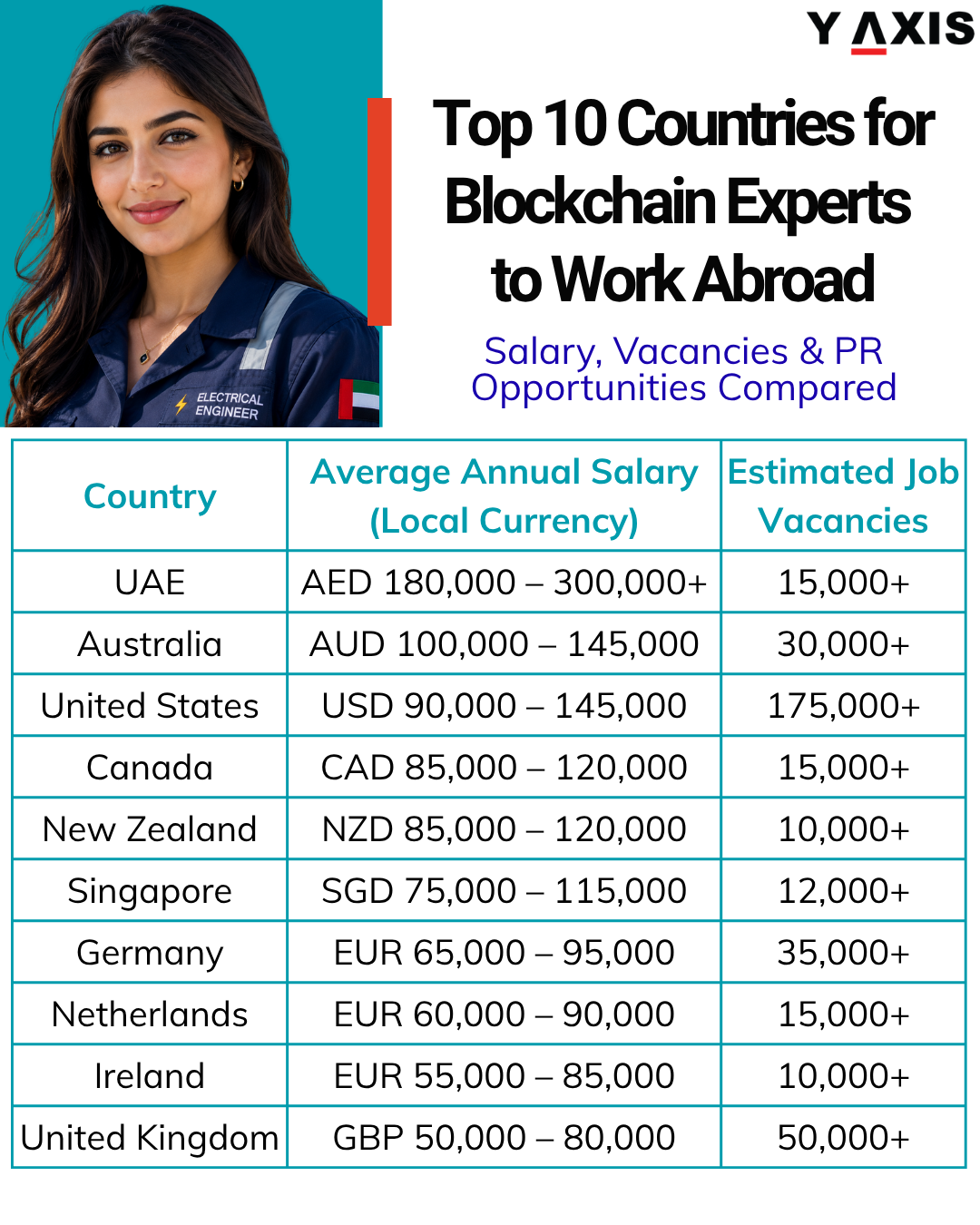
Top 10 Countries for Blockchain Experts to Work Abroad: Salary, Demand & PR Opportunities Compared
Top 10 Countries for Blockchain Experts to Work Abroad: Salary, Demand & PR Opportunities Compared
The top 10 countries for Blockchain Experts to work abroad are the United States, Switzerland, Singapore, the United Kingdom, Hong Kong, Canada, the UAE, Australia, Germany, and the Netherlands. These destinations offer strong opportunities for Blockchain Developers, Blockchain Engineers, Smart Contract Developers, Web3 Developers, Blockchain Architects, and Blockchain Security Engineers, with competitive salaries, rising job demand, work visa options, and permanent residency pathways.
Hiring for blockchain roles is being driven by digital assets, tokenisation, decentralised finance, blockchain-based payments, and enterprise applications. The global Web3 market is projected to reach USD 33.53 billion by 2030, growing at a 49.3% CAGR and supporting continued demand for blockchain and Web3 roles.
*Want to work abroad? Sign up with Y-Axis Resume Marketing Services to find right job faster.
Benefits of Working Abroad as a Blockchain Expert
Working abroad can help Blockchain Experts earn more, work in established digital-asset markets, gain experience with large-scale blockchain projects, and move into specialised roles. Global Web3 salaries range from USD 45,000 to USD 375,000+, while international markets offer opportunities across smart contracts, DeFi, tokenisation, blockchain infrastructure, and digital-asset platforms.
- Higher salaries: Earn competitive pay in major blockchain and Web3 markets.
- Larger job markets: Access roles with blockchain firms, banks, fintech companies, and digital-asset platforms.
- Advanced projects: Work on smart contracts, DeFi, tokenisation, and blockchain infrastructure.
- Specialised roles: Progress into Blockchain Architect, Protocol Engineer, and Security Engineer positions.
- International projects: Work on blockchain products for global users and businesses.
- Visa and PR options: Access work visas and PR pathways in countries such as Canada, Australia, the UK, Germany, and the Netherlands.
How to Choose the Right Country for Blockchain Experts to Work Abroad?
The best country depends on where Blockchain Experts can find strong job demand, competitive salaries, established Web3 ecosystems, and suitable immigration options. Blockchain Developers, Smart Contract Engineers, Blockchain Architects, and Blockchain Security Engineers should compare each destination based on these factors before choosing where to work abroad.
- Salary levels: Compare salaries for specific blockchain roles.
- Job demand: Check demand for blockchain, Web3, fintech, and digital-asset roles.
- Industry ecosystem: Assess blockchain companies, startups, banks, and technology firms.
- Work visa: Compare visa requirements, sponsorship, and processing conditions.
- PR pathways: Check permanent residency routes and eligibility requirements.
- Cost of living: Compare housing, taxes, healthcare, and daily expenses with salary.
Top 10 Countries for Blockchain Experts to Work Abroad
Blockchain Experts can find international opportunities in countries with established technology, fintech, and digital-asset industries. The United States, Switzerland, Singapore, the UK, Canada, and the UAE offer opportunities in blockchain development, smart contracts, Web3, digital assets, and blockchain security. Salaries, demand for specific blockchain roles, strength of the local industry, work visa requirements, and PR options vary across countries, making each destination suitable for different career and relocation goals.
|
Country |
Average Annual Salary (Local Currency) |
Estimated Blockchain Expert Job Vacancies |
|
United States |
USD 108,000 – 164,000 |
50,000+ |
|
Switzerland |
CHF 90,000 – 170,000 |
8,000+ |
|
United Kingdom |
GBP 60,000 – 130,000 |
25,000+ |
|
Canada |
CAD 90,000 – 135,000 |
8,000+ |
|
Germany |
EUR 64,000 – 114,000 |
20,000+ |
|
Singapore |
SGD 84,000 – 180,000 |
8,000+ |
|
Hong Kong |
HKD 600,000 – 1,440,000 |
8,000+ |
|
Australia |
AUD 90,000 – 140,000 |
6,000+ |
|
UAE |
AED 180,000 – 360,000 |
15,000+ |
|
Netherlands |
EUR 54,000 – 108,000 |
5,000+ |
*Want to work abroad? Sign up with Y-Axis Resume Marketing Services to find right job faster.
Best Countries for Blockchain Experts to Work and Settle Abroad
Blockchain Experts looking to work and settle abroad can compare countries based on salary, job demand, digital-asset adoption, work visa options, and permanent residency pathways. The United States, United Kingdom, Germany, UAE, Switzerland, Singapore, Canada, and Australia offer opportunities in blockchain development, smart contracts, Web3, tokenisation, digital assets, infrastructure, and security, along with routes to build international experience and pursue long-term residence.
Blockchain Expert Jobs in the United States
The United States offers the widest range of career opportunities for Blockchain Experts, from cryptocurrency and Web3 companies to banks, payment networks, fintech firms and cybersecurity companies. Blockchain applications are expanding into stablecoins, tokenised assets, digital payments, decentralised applications and enterprise infrastructure, creating opportunities for Blockchain Developers, Blockchain Engineers, Smart Contract Developers and Blockchain Security Engineers. O*NET classifies Blockchain Engineer as a Bright Outlook, new and emerging occupation, with skills including Solidity, Python, Rust and Go appearing in the occupation profile. International Blockchain Experts can use the H-1B visa for qualifying specialty-occupation roles, while EB-2 and EB-3 offer employment-based routes toward permanent residence.
|
Factor |
Details |
|
Blockchain Expert Job Market & Job Vacancies for the Next Decade |
The United States is projected to have more than 50,000 Blockchain Expert job vacancies over the next decade, with demand across digital assets, fintech, payments, blockchain infrastructure, smart contracts, cybersecurity and enterprise applications. |
|
Investment in Blockchain & Digital Asset Technology |
The U.S. blockchain market is projected to grow from around USD 3.3 billion to USD 23 billion, representing a 62.4% CAGR. Growth is being driven by institutional blockchain adoption, tokenisation, stablecoins, digital payments and blockchain infrastructure. |
|
Top Companies Hiring Blockchain Experts |
Coinbase, Ripple, JPMorgan Chase, Consensys, IBM, Microsoft, Amazon, Google, Chainlink and Circle have blockchain, digital-asset or distributed-ledger operations relevant to Blockchain Developers and Engineers. |
|
Top Cities for Blockchain Expert Jobs |
New York leads in financial blockchain and digital-asset activity, while San Francisco, Miami, Austin, Seattle and Boston offer opportunities across blockchain startups, fintech, software and digital-asset companies. |
|
In-Demand Blockchain Roles & Skills |
Key roles include Blockchain Developers, Blockchain Engineers, Smart Contract Developers, Protocol Engineers, Blockchain Architects and Blockchain Security Engineers. Employer demand includes Solidity, Python, Rust, Go, Docker, AWS, Kubernetes, JavaScript and TypeScript. |
|
Work Visa Options |
Blockchain Developers and Engineers can use the H-1B visa for specialty-occupation jobs requiring specialised knowledge and a relevant degree or equivalent qualification. The O-1A visa can also apply to Blockchain Experts with sustained national or international recognition. |
|
Fast-Track Hiring Options |
The O-1A visa can provide a direct employment route without the H-1B annual lottery when the Blockchain Expert has evidence of extraordinary ability. The EB-1A route can also support permanent residence for Blockchain Experts with extraordinary ability. |
|
PR / Long-Term Residence Opportunities |
Blockchain Experts can pursue employment-based permanent residence through EB-2 or EB-3. Blockchain Engineers with extraordinary ability can also pursue EB-1A, while an employer can sponsor an EB-2 National Interest Waiver when the case satisfies the NIW requirements. |
|
Eligibility for Dependents |
An H-1B Blockchain Expert can bring a spouse and unmarried children under 21 through H-4 status. O-1A holders can bring the same family members through O-3 status. |
|
Benefits for Family Members |
H-4 spouses can obtain employment authorization in specific circumstances, while H-4 children can study in the U.S. O-3 spouses and children can study, but O-3 status does not provide employment authorization. |
Blockchain Expert Jobs in Switzerland
Switzerland is a standout destination for Blockchain Experts who want to work directly with financial institutions and digital-asset companies. Zug's Crypto Valley has developed into a major blockchain centre, supported by Zurich's banking and technology ecosystem and Geneva's international financial sector. The country has around 1,766 blockchain companies, with Swiss blockchain businesses attracting a significant share of European blockchain investment. The strongest opportunities are in protocol engineering, smart contracts, tokenisation, digital securities, custody technology and blockchain security. This makes Switzerland particularly relevant to Blockchain Experts with both technical and financial-market knowledge. Foreign Blockchain Experts can use Swiss employment-permit routes, while the C settlement permit provides a pathway to permanent residence after the required residence period.
|
Factor |
Details |
|
Blockchain Expert Job Market & Job Vacancies for the Next Decade |
Switzerland is projected to have around 8,000 Blockchain Expert job vacancies over the next decade, with demand across digital assets, financial services, tokenisation, blockchain infrastructure, smart contracts and blockchain security. |
|
Investment in Blockchain & Digital Asset Technology |
Switzerland's blockchain technology market is projected to grow from around USD 1.03 billion to USD 7.98 billion, representing a 67.1% CAGR. Growth is expected across tokenisation, digital assets, financial infrastructure, supply-chain applications and enterprise blockchain. |
|
Top Companies Hiring Blockchain Experts |
UBS, Swisscom, Sygnum, Taurus, PostFinance, Credit Suisse, SIX Group and Crypto Finance have blockchain, digital-asset or distributed-ledger activities relevant to Blockchain Developers and Engineers. |
|
Top Cities for Blockchain Expert Jobs |
Zug is the centre of Switzerland's Crypto Valley. Zurich adds major banking, fintech and blockchain opportunities, while Geneva, Lausanne and Lugano also have digital-asset and technology activity. |
|
In-Demand Blockchain Roles & Skills |
Key roles include Blockchain Developers, Blockchain Engineers, Smart Contract Developers, Protocol Engineers, Blockchain Architects and Blockchain Security Engineers. Skills include Solidity, Ethereum, Rust, Python, smart contracts, cryptography, distributed-ledger architecture and cybersecurity. |
|
Work Visa Options |
Blockchain Experts from outside the EU/EFTA can use L or B residence permits for employment. Swiss employers generally need to demonstrate that the role cannot be filled by a suitable Swiss or EU/EFTA candidate. |
|
Fast-Track Hiring Options |
Switzerland does not have a dedicated blockchain fast-track visa. EU/EFTA nationals have simpler employment procedures, while non-EU/EFTA Blockchain Experts require employer sponsorship and approval under Switzerland's work-permit system. |
|
PR / Long-Term Residence Opportunities |
A B permit holder can generally apply for a C settlement permit after 10 years of residence. Citizens of certain countries can obtain the C permit after five years when the applicable bilateral and integration conditions are satisfied. |
|
Eligibility for Dependents |
A Blockchain Expert holding a Swiss residence permit can generally bring a spouse and unmarried children under 18 through family reunification, subject to accommodation and other residence requirements. |
|
Benefits for Family Members |
A spouse admitted through family reunification can generally work in Switzerland, while dependent children can attend school. Family members receive residence rights linked to the family-reunification permit. |
*Want to Work in Switzerland? Let Y-Axis guide you through application process.
Blockchain Expert Jobs in the United Kingdom
The UK's strongest blockchain opportunity is the growing use of distributed-ledger technology inside financial markets. London brings together banks, asset managers, fintech companies and technology firms that are exploring tokenised funds, securities, collateral, settlement systems and digital assets. The FCA and Bank of England are actively working on the regulatory framework for tokenisation in wholesale markets, giving institutional blockchain projects a stronger foundation. This creates demand for Blockchain Developers, Smart Contract Engineers, Tokenisation Engineers, Digital Asset Architects and Blockchain Security Engineers. International Blockchain Experts can enter through the Skilled Worker visa with approved sponsorship and a qualifying role, while the route can lead to Indefinite Leave to Remain after the required qualifying residence period.
|
Factor |
Details |
|
Blockchain Expert Job Market & Job Vacancies for the Next Decade |
The UK is projected to have around 25,000 Blockchain Expert job vacancies over the next decade, with opportunities in digital assets, fintech, banking, tokenisation, blockchain infrastructure and financial-market technology. |
|
Investment in Blockchain & Digital Asset Technology |
The UK's blockchain and digital-asset ecosystem continues to attract institutional investment, with the country recording around USD 1.8 billion in blockchain venture funding. Investment is increasingly moving toward tokenised assets, stablecoins, digital securities and blockchain-based financial infrastructure. |
|
Top Companies Hiring Blockchain Experts |
Barclays, HSBC, Standard Chartered, JPMorgan, IBM, Accenture, Deloitte, Revolut and Coinbase have blockchain, digital-asset, fintech or related operations in the UK. |
|
Top Cities for Blockchain Expert Jobs |
London is the UK's dominant blockchain and digital-asset hub, supported by its banking and fintech ecosystem. Manchester, Edinburgh, Bristol, Cambridge and Birmingham also have technology and financial-services opportunities. |
|
In-Demand Blockchain Roles & Skills |
Key roles include Blockchain Developers, Blockchain Engineers, Smart Contract Developers, Blockchain Architects, Tokenisation Engineers and Blockchain Security Engineers. Important skills include Solidity, Ethereum, Rust, Python, smart contracts, distributed-ledger architecture, cryptography and cybersecurity. |
|
Work Visa Options |
Blockchain Developers and Engineers can use the Skilled Worker visa when an approved UK employer sponsors a qualifying role. The Global Talent visa is another route for recognised leaders or potential leaders in digital technology. |
|
Fast-Track Hiring Options |
The Global Talent visa does not require a job offer or employer sponsorship and can provide a direct immigration route for recognised digital-technology talent. The Skilled Worker visa also has priority processing options in certain circumstances. |
|
PR / Long-Term Residence Opportunities |
Blockchain Experts on the Skilled Worker visa can apply for Indefinite Leave to Remain after five years when the settlement requirements are satisfied. Global Talent visa holders can have a three- or five-year route to settlement, depending on the basis of their application. |
|
Eligibility for Dependents |
A Blockchain Expert on the Skilled Worker or Global Talent route can generally bring a spouse or partner and dependent children under the dependant rules. |
|
Benefits for Family Members |
A dependant partner can generally work in the UK, while dependent children can attend school. Dependants can also apply for settlement when they satisfy the relevant ILR requirements. Access to NHS services depends on the visa and Immigration Health Surcharge rules. |
* Want to Work in the UK? Let Y-Axis guide you through the steps.
Blockchain Expert Jobs in Canada
Canada is developing a blockchain market with a strong focus on digital payments and regulated stablecoins. Its emerging stablecoin framework covers reserve assets, redemption, governance, risk management and data security, creating opportunities for Blockchain Experts working on payment infrastructure and digital financial products. Blockchain Developers, Smart Contract Engineers, Stablecoin Engineers, Digital Wallet Developers and Blockchain Security Engineers can apply their skills across fintech and financial services. Toronto, Vancouver and Montreal remain important technology centres, while Canada's immigration system gives the country an additional advantage for people planning to settle abroad. Express Entry and Provincial Nominee Programs provide permanent-residence pathways for skilled workers, while employer-specific work permits can provide an initial route into Canadian blockchain employment.
|
Factor |
Details |
|
Blockchain Expert Job Market & Job Vacancies for the Next Decade |
Canada is projected to have around 8,000 Blockchain Expert job vacancies over the next decade, with demand for Blockchain Developers, Blockchain Engineers, Smart Contract Developers, Blockchain Architects and Blockchain Security Engineers across fintech, banking, payments and digital-asset infrastructure. |
|
Investment in Blockchain & Digital Asset Technology |
Canada's blockchain technology market is valued at around USD 4.1 billion and is projected to reach approximately USD 29.7 billion, driven by blockchain infrastructure, tokenisation, smart contracts, stablecoins and digital payments. |
|
Top Companies Hiring Blockchain Experts |
IBM, Deloitte, Accenture, RBC, TD, CIBC and Shopify have blockchain, fintech or digital-asset operations relevant to Blockchain Developers, Blockchain Engineers, Smart Contract Developers and blockchain security roles. |
|
Top Cities for Blockchain Expert Jobs |
Toronto is Canada's leading fintech centre, while Vancouver has a strong blockchain and Web3 ecosystem. Montreal, Ottawa, Calgary and Waterloo also have established technology and financial-services markets. |
|
In-Demand Blockchain Roles & Skills |
Key roles include Blockchain Developers, Blockchain Engineers, Smart Contract Developers, Blockchain Architects, Protocol Developers and Blockchain Security Engineers. Skills include Solidity, Rust, Python, Ethereum, smart-contract development, distributed-ledger architecture and cybersecurity. |
|
Work Visa Options |
Blockchain Developers and Engineers with a Canadian job offer can use an employer-specific work permit. The Global Talent Stream covers software engineers and designers (NOC 21231) and software developers and programmers (NOC 21232), which can apply when the Blockchain Expert's actual duties match these occupations. |
|
Fast-Track Hiring Options |
The Global Talent Stream provides expedited processing for covered technology occupations. The Canadian employer submits the required application and Labour Market Benefits Plan before the Blockchain Expert applies for the work permit. |
|
PR / Long-Term Residence Opportunities |
Blockchain Developers and Engineers can pursue Express Entry, including the Federal Skilled Worker Program and Canadian Experience Class, or apply through a Provincial Nominee Program for permanent residence. |
|
Eligibility for Dependents |
A Blockchain Expert can include a spouse or common-law partner and dependent children when the selected Canadian immigration program permits accompanying family members. |
|
Benefits for Family Members |
A spouse or common-law partner can apply for a work permit under Canada's family-work-permit rules, while dependent children can attend Canadian schools. Healthcare coverage depends on the province and the family's immigration status. |
*Want to Work in Canada? Let Y-Axis guide you through application process.
Blockchain Expert Jobs in Germany
Germany offers a particularly strong opportunity for Blockchain Experts interested in industrial and enterprise applications. Blockchain is being explored across automotive manufacturing, logistics, supply chains, financial services, industrial data and digital identity, giving the country's market a broader base than cryptocurrency companies alone. The automotive sector is especially relevant, with distributed-ledger technology being used in areas such as supply-chain processes and data management. This creates opportunities for Enterprise Blockchain Developers, DLT Engineers, Blockchain Architects, Smart Contract Developers and Blockchain Security Engineers. Berlin provides access to Germany's technology and startup ecosystem, while Frankfurt offers opportunities connected to banking and financial infrastructure. International Blockchain Experts can use the EU Blue Card or skilled-worker residence routes, with permanent settlement available through Germany's residence system.
|
Factor |
Details |
|
Blockchain Expert Job Market & Job Vacancies for the Next Decade |
Germany is projected to have around 20,000 Blockchain Expert job vacancies over the next decade, with demand across enterprise blockchain, financial services, automotive, manufacturing, logistics and digital-asset infrastructure. |
|
Investment in Blockchain & Digital Asset Technology |
Germany's blockchain startups have received around EUR 327 million in venture funding, with blockchain accounting for 4% of total VC funding and 5.5% of VC deals. Around 27% of German companies are using, planning to use or discussing blockchain technology. |
|
Top Companies Hiring Blockchain Experts |
SAP, Siemens, Bosch, Deutsche Bank, Deutsche Telekom, BMW, Volkswagen and Deutsche Börse have blockchain, digital-asset, fintech or enterprise-DLT activities relevant to Blockchain Developers and Engineers. |
|
Top Cities for Blockchain Expert Jobs |
Berlin is Germany's main blockchain and technology hub. Frankfurt offers opportunities in banking and digital assets, while Munich, Stuttgart and Hamburg have strong automotive, industrial and technology markets. |
|
In-Demand Blockchain Roles & Skills |
Key roles include Blockchain Developers, Blockchain Engineers, DLT Engineers, Smart Contract Developers, Blockchain Architects and Blockchain Security Engineers. Skills include Solidity, Ethereum, Hyperledger, Rust, Python, smart-contract development, distributed-ledger architecture and cybersecurity. |
|
Work Visa Options |
Blockchain Developers and Engineers can use the EU Blue Card when the job, salary and qualification requirements are met. Germany also offers skilled-worker residence routes and the Opportunity Card for job searches. |
|
Fast-Track Hiring Options |
The Accelerated Skilled Worker Procedure allows a German employer to request faster processing through the local foreigners authority for a Blockchain Expert's employment and residence procedure. |
|
PR / Long-Term Residence Opportunities |
An EU Blue Card holder can obtain a settlement permit after 27 months with A1 German or 21 months with B1 German, provided the other settlement requirements are satisfied. |
|
Eligibility for Dependents |
Spouses and dependent children can accompany an EU Blue Card holder through family reunification under Germany's family-reunification rules. |
|
Benefits for Family Members |
A spouse joining an EU Blue Card holder can work in Germany without a separate work permit, while dependent children can attend German schools. Family members can also receive residence permits through family reunification. |
*Want to Work in Germany? Let Y-Axis guide you through application process.
Blockchain Expert Jobs in Singapore
Singapore has turned blockchain into an institutional finance opportunity, particularly through asset tokenisation. Banks, asset managers and technology companies are testing blockchain applications for tokenised funds, bonds, deposits, foreign exchange and digital financial infrastructure. Project Guardian has brought together more than 40 financial institutions, industry groups and international policymakers, giving Singapore one of the strongest institutional tokenisation ecosystems in Asia. This creates opportunities for Tokenisation Engineers, Smart Contract Developers, Blockchain Infrastructure Engineers, Digital Asset Product Managers and Blockchain Security Engineers. Singapore is particularly attractive for Blockchain Experts who understand both blockchain and financial markets. The Employment Pass provides the main employment route for foreign technology talent, while permanent residence can be pursued through Singapore's immigration system.
|
Factor |
Details |
|
Blockchain Expert Job Market & Job Vacancies for the Next Decade |
Singapore is projected to have around 8,000 Blockchain Expert job vacancies over the next decade, with opportunities in tokenisation, digital assets, financial infrastructure, payments, smart contracts and blockchain security. |
|
Investment in Blockchain & Digital Asset Technology |
Singapore's Project Guardian has brought together more than 40 financial institutions, industry groups and international policymakers to develop commercial applications for asset tokenisation. Projects cover tokenised funds, fixed income, foreign exchange and digital financial infrastructure, creating demand for Blockchain Experts. |
|
Top Companies Hiring Blockchain Experts |
DBS, Standard Chartered, Citi, JPMorgan, Ant Group, Grab, IBM, Microsoft and Chainlink have blockchain, digital-asset, fintech or distributed-ledger activities in Singapore. |
|
Top Cities for Blockchain Expert Jobs |
Singapore is the country's primary blockchain and digital-asset hub, bringing together banks, fintech companies, asset managers, technology companies and Web3 businesses. |
|
In-Demand Blockchain Roles & Skills |
Key roles include Blockchain Developers, Blockchain Engineers, Smart Contract Developers, Tokenisation Engineers, Blockchain Infrastructure Engineers and Blockchain Security Engineers. Skills include Solidity, Ethereum, Rust, Python, smart contracts, distributed-ledger architecture, cryptography and cybersecurity. |
|
Work Visa Options |
Blockchain Developers and Engineers can use the Employment Pass (EP) for qualifying professional roles. The Personalised Employment Pass (PEP) provides another route for high-earning foreign professionals without tying the pass to one employer. |
|
Fast-Track Hiring Options |
The Employment Pass application can use Singapore's MOM EP eService, allowing employers or authorised employment agents to submit applications electronically. Companies also benefit from the Tech@SG programme when recruiting foreign technology talent for qualifying businesses. |
|
PR / Long-Term Residence Opportunities |
Blockchain Experts holding an Employment Pass or other eligible long-term work pass can apply for Singapore Permanent Residence through the Professionals, Technical Personnel and Skilled Workers scheme. |
|
Eligibility for Dependents |
An Employment Pass holder earning at least SGD 6,000 per month can apply for Dependant's Passes for a legally married spouse and unmarried children under 21. |
|
Benefits for Family Members |
Dependant's Pass holders can live in Singapore, while dependent children can attend schools subject to Singapore's admission requirements. A spouse who wants to work requires an appropriate Singapore work pass. |
*Want to Work in Singapore? Let Y-Axis guide you through every step of the process.
Blockchain Expert Jobs in Hong Kong
Hong Kong is building its blockchain sector around regulated virtual assets, stablecoins and financial-market applications. Its regulatory approach covers licensed virtual-asset platforms and is expanding into stablecoin issuance, custody, tokenisation and digital-asset services. This gives Blockchain Experts opportunities that combine technology with banking, investment and regulatory knowledge. Demand is particularly relevant to Stablecoin Engineers, Blockchain Developers, Smart Contract Engineers, Tokenisation Engineers, Blockchain Security Engineers and Digital Asset Compliance Specialists. Hong Kong's role as an international financial centre also connects its blockchain market with major Asian investment and banking networks. Foreign Blockchain Experts can use the General Employment Policy to work in Hong Kong, while seven years of ordinary residence can provide a route to permanent residency.
|
Factor |
Details |
|
Blockchain Expert Job Market & Job Vacancies for the Next Decade |
Hong Kong is projected to have around 8,000 Blockchain Expert job vacancies over the next decade, with opportunities across virtual assets, stablecoins, tokenisation, digital payments, blockchain infrastructure and financial services. |
|
Investment in Blockchain & Digital Asset Technology |
Hong Kong is strengthening its digital-asset ecosystem through HKD 7 billion in funding for the Cyberport Macro Fund, supporting technology startups and innovation. The government is also developing tokenisation, stablecoin infrastructure and digital-asset markets, creating new applications for blockchain technology. |
|
Top Companies Hiring Blockchain Experts |
HashKey Group, Crypto.com, Animoca Brands, HSBC, Standard Chartered, Bank of China (Hong Kong), Ant Digital Technologies and ZA Bank have blockchain, virtual-asset, tokenisation or digital-finance operations in Hong Kong. |
|
Top Cities for Blockchain Expert Jobs |
Hong Kong is the main location for blockchain and virtual-asset jobs, with opportunities concentrated around the city's financial district, fintech ecosystem, licensed virtual-asset platforms and technology companies. |
|
In-Demand Blockchain Roles & Skills |
Key roles include Blockchain Developers, Blockchain Engineers, Smart Contract Developers, Tokenisation Engineers, Digital Asset Engineers and Blockchain Security Engineers. Skills include Solidity, Ethereum, Rust, Python, smart contracts, cryptography, distributed-ledger architecture and cybersecurity. |
|
Work Visa Options |
Blockchain Developers and Engineers can use the General Employment Policy (GEP) when they have a confirmed offer for a role that requires their skills and experience. The Technology Talent Admission Scheme (TechTAS) can also support recruitment for qualifying technology roles. |
|
Fast-Track Hiring Options |
The Technology Talent Admission Scheme provides an expedited route for eligible companies to recruit overseas technology talent. Hong Kong's Top Talent Pass Scheme also provides a direct route for high-income talent and graduates of leading universities without requiring a prior job offer. |
|
PR / Long-Term Residence Opportunities |
Blockchain Experts can apply for Hong Kong permanent residency after seven years of continuous ordinary residence, subject to the right-of-abode requirements. |
|
Eligibility for Dependents |
A Blockchain Expert admitted under the General Employment Policy can generally sponsor a spouse or recognised partner and unmarried dependent children under 18 for dependant visas. |
|
Benefits for Family Members |
Dependants can live and study in Hong Kong, while a spouse or recognised partner can generally work without obtaining a separate employment visa. Family members can continue their residence while the sponsor maintains the relevant Hong Kong status. |
Blockchain Expert Jobs in Australia
Australia's blockchain market is moving from experimentation toward a more structured financial-services environment. New digital-asset rules are bringing digital-asset platforms and tokenised custody platforms into the financial-services regulatory framework, creating opportunities in tokenisation, custody, payments and digital-asset infrastructure. This gives Blockchain Developers and Engineers opportunities across fintech, banking and financial technology rather than limiting the market to Web3 startups. Roles include Blockchain Developers, Smart Contract Engineers, Tokenisation Engineers, Blockchain Architects and Blockchain Security Engineers, particularly around Sydney and Melbourne. Australia also has several migration options for technology workers. Skills in Demand visas, employer-sponsored visas and skilled migration pathways can provide routes into employment, with permanent residence available through specific Australian visa categories.
|
Factor |
Details |
|
Blockchain Expert Job Market & Job Vacancies for the Next Decade |
Australia is projected to have around 6,000 Blockchain Expert job vacancies over the next decade, covering Blockchain Developers, Blockchain Engineers, Smart Contract Developers, Blockchain Architects and Blockchain Security Engineers across fintech, banking, digital assets and enterprise blockchain. |
|
Investment in Blockchain & Digital Asset Technology |
Australia's digital-finance sector has an estimated AUD 24 billion annual economic opportunity from technologies including tokenisation, digital currencies and distributed-ledger systems. Financial institutions are expanding work on tokenised assets, digital payments and blockchain-based settlement infrastructure. |
|
Top Companies Hiring Blockchain Experts |
Commonwealth Bank, ANZ, NAB, Westpac, IBM, Accenture, Deloitte and Ripple have blockchain, digital-asset, fintech or related financial-technology activities in Australia. |
|
Top Cities for Blockchain Expert Jobs |
Sydney and Melbourne are the strongest markets for Blockchain Experts, supported by major banks, fintech companies and technology businesses. Brisbane, Canberra and Perth also have technology and financial-services opportunities. |
|
In-Demand Blockchain Roles & Skills |
Key roles include Blockchain Developers, Blockchain Engineers, Smart Contract Developers, Blockchain Architects, Tokenisation Engineers and Blockchain Security Engineers. Important skills include Solidity, Rust, Python, Ethereum, smart-contract development, distributed-ledger architecture, cryptography, cloud infrastructure and cybersecurity. |
|
Work Visa Options |
Blockchain Developers and Engineers can use the Skills in Demand visa (subclass 482) when an approved Australian employer sponsors a nominated position. The Employer Nomination Scheme (subclass 186) provides a permanent employer-sponsored route. |
|
Fast-Track Hiring Options |
The Skills in Demand visa (subclass 482) provides an employer-sponsored route for Blockchain Experts with an approved sponsor and nominated occupation. The National Innovation visa (subclass 858) provides another route for internationally recognised technology talent with a strong record of achievement. |
|
PR / Long-Term Residence Opportunities |
Blockchain Experts can explore the Skilled Independent visa (subclass 189), Skilled Nominated visa (subclass 190), Employer Nomination Scheme (subclass 186) and Skilled Work Regional visa (subclass 491), depending on the nominated occupation and visa requirements. |
|
Eligibility for Dependents |
Spouses, de facto partners and dependent children can be included in an Australian visa application when the selected visa allows family members to accompany the main applicant. |
|
Benefits for Family Members |
Spouses can receive work rights according to the visa conditions, while dependent children can attend Australian schools. Healthcare access depends on the family's visa status and Australia's health-insurance requirements. |
*Want to Work in Australia? Let Y-Axis guide you through application process.
Blockchain Expert Jobs in the UAE
The UAE has created a dedicated business environment for blockchain and virtual assets, making it one of the most distinctive markets in the Middle East. Dubai's VARA regulates activities including virtual-asset exchange, custody, broker-dealer services, investment management and tokenisation, while Abu Dhabi's ADGM provides another established digital-asset ecosystem. This regulatory infrastructure supports direct demand for Blockchain Developers, Smart Contract Engineers, Tokenisation Engineers, Digital Asset Architects, Blockchain Security Engineers and Blockchain Compliance Specialists. Dubai also gives Blockchain Experts access to a wider MENA market through its financial, technology and investment networks. Foreign Blockchain Experts can use employer-sponsored residence routes, while the UAE Golden Visa offers long-term residence for qualifying specialised technology talent.
|
Factor |
Details |
|
Blockchain Expert Job Market & Job Vacancies for the Next Decade |
The UAE is projected to have around 15,000 Blockchain Expert job vacancies over the next decade, with demand across virtual assets, blockchain infrastructure, tokenisation, fintech, digital payments and blockchain security. |
|
Investment in Blockchain & Digital Asset Technology |
The UAE's blockchain and digital-asset market is projected to grow strongly as Dubai and Abu Dhabi expand virtual-asset infrastructure, tokenisation and blockchain-based financial services. The country's digital economy strategy also targets AED 100 billion in additional annual GDP contribution from the digital economy. |
|
Top Companies Hiring Blockchain Experts |
Binance, Crypto.com, Chainlink, Ripple, IBM, Microsoft, Emirates NBD and Mashreq have blockchain, digital-asset, fintech or related technology operations in the UAE. |
|
Top Cities for Blockchain Expert Jobs |
Dubai is the UAE's leading virtual-asset and blockchain hub, supported by VARA-regulated businesses. Abu Dhabi is another major centre through ADGM, while Sharjah has a growing technology ecosystem. |
|
In-Demand Blockchain Roles & Skills |
Key roles include Blockchain Developers, Blockchain Engineers, Smart Contract Developers, Tokenisation Engineers, Blockchain Architects, Blockchain Security Engineers and Digital Asset Specialists. Skills include Solidity, Ethereum, Rust, Python, smart contracts, cryptography, distributed-ledger architecture and cybersecurity. |
|
Work Visa Options |
Blockchain Experts can use an employer-sponsored UAE employment residence visa. The Green Residency provides a longer-term residence route for skilled employees and freelancers, while the Golden Residency offers long-term residence for qualifying specialised talent. |
|
Fast-Track Hiring Options |
The UAE Golden Residency provides a long-term residence route without requiring a traditional employer-sponsored residence arrangement. Blockchain and digital-technology talent can use the specialised-talent category when the UAE's requirements are satisfied. |
|
PR / Long-Term Residence Opportunities |
The UAE does not operate a conventional permanent-residence or PR system. Golden Residency and Green Residency provide renewable long-term residence, with the Golden Residency offering 5- or 10-year residence depending on the category. |
|
Eligibility for Dependents |
Golden and Green Residency holders can sponsor their spouse and children for UAE residence, subject to the applicable family-residence requirements. |
|
Benefits for Family Members |
Sponsored family members can live and study in the UAE, while spouses can work subject to UAE employment rules. Long-term residence for the family can continue alongside the main resident's Golden or Green Residency. |
Blockchain Expert Jobs in the Netherlands
The Netherlands is particularly attractive for Blockchain Experts combining blockchain with fintech, payments and enterprise technology. Amsterdam's technology ecosystem supports applications in digital identity, payment systems, tokenisation, financial infrastructure and enterprise blockchain, while the country's position inside the EU connects companies with the wider European digital-asset market. This creates opportunities for Blockchain Developers, DLT Engineers, Smart Contract Developers, Blockchain Solution Architects and Blockchain Security Engineers. The Netherlands is a strong choice for Blockchain Experts who want to work on practical business applications rather than cryptocurrency alone. Foreign Blockchain Experts can use the Highly Skilled Migrant route or EU Blue Card, while permanent residence can be pursued after the required period of lawful residence.
|
Factor |
Details |
|
Blockchain Expert Job Market & Job Vacancies for the Next Decade |
The Netherlands is projected to have around 5,000 Blockchain Expert job vacancies over the next decade, with opportunities in fintech, payments, tokenisation, digital assets, blockchain infrastructure and enterprise DLT. |
|
Investment in Blockchain & Digital Asset Technology |
The Netherlands blockchain technology market is projected to grow from around USD 474.9 million to USD 3.7 billion, representing approximately 680% growth. Expansion is expected across tokenisation, digital payments, smart contracts, blockchain infrastructure and enterprise applications. |
|
Top Companies Hiring Blockchain Experts |
ING, ABN AMRO, Adyen, Bitvavo, Amdax, ASML, Philips and Shell have fintech, digital-asset, blockchain or technology activities relevant to Blockchain Developers and Engineers. |
|
Top Cities for Blockchain Expert Jobs |
Amsterdam is the country's main blockchain and fintech centre. Eindhoven has strong engineering and deep-tech activity, while Rotterdam and Utrecht offer opportunities across financial and enterprise technology. |
|
In-Demand Blockchain Roles & Skills |
Key roles include Blockchain Developers, Blockchain Engineers, Smart Contract Developers, DLT Engineers, Blockchain Architects and Blockchain Security Engineers. Skills include Solidity, Ethereum, Rust, Python, smart contracts, distributed-ledger architecture, cryptography and cybersecurity. |
|
Work Visa Options |
Blockchain Developers and Engineers can use the Highly Skilled Migrant residence permit through a recognised Dutch sponsor. The EU Blue Card is another route for highly qualified employment. |
|
Fast-Track Hiring Options |
The Highly Skilled Migrant route allows a recognised Dutch sponsor to submit the residence application directly to the IND, providing a streamlined employer-led process for Blockchain Experts. |
|
PR / Long-Term Residence Opportunities |
A Blockchain Expert can apply for permanent residence after five consecutive years of lawful residence when the Dutch residence, income, civic-integration and other requirements are satisfied. |
|
Eligibility for Dependents |
Spouses, registered partners and dependent children can accompany a Blockchain Expert through the Dutch family-reunification route, subject to the applicable family-residence requirements. |
|
Benefits for Family Members |
A spouse or partner of a Highly Skilled Migrant can generally work without a separate work permit, while dependent children can attend Dutch schools. Family members receive residence permits linked to their family-reunification status. |
Job Outlook for Blockchain Experts over the Next Decade
The outlook for Blockchain Experts remains strong as blockchain moves into mainstream financial and enterprise applications. The global blockchain technology market is projected to reach USD 577.36 billion, growing at a 36.5% CAGR, while the blockchain distributed-ledger market is forecast to reach USD 53.03 billion. Growth is expected across tokenisation, stablecoins, smart contracts, digital payments, financial settlement and enterprise blockchain.
This expansion should increase demand for Blockchain Developers, Blockchain Engineers, Smart Contract Developers, Protocol Engineers, Blockchain Architects and Blockchain Security Engineers. Financial centres including the United States, Switzerland, UK, Singapore, UAE and Hong Kong are developing regulated digital-asset markets, creating additional opportunities for Blockchain Experts with skills in blockchain development, cybersecurity and digital finance.
*Want to work abroad? Sign up with Y-Axis Resume Marketing Services to find right job faster.
FAQs
Which country is best for Blockchain Experts to work abroad?
The United States is one of the strongest destinations because of its large technology, fintech and digital-asset market. Switzerland, the UK, Singapore, UAE, Canada, Australia, Germany, Hong Kong and the Netherlands also offer strong opportunities, with differences in salary, job demand, work visas and PR pathways.
Which countries have the highest demand for Blockchain Experts?
The United States, Switzerland, UK, Singapore, UAE, Canada, Germany, Australia, Hong Kong and the Netherlands have strong demand across blockchain development, smart contracts, tokenisation, digital assets, fintech and blockchain security.
Which country pays the highest salary for Blockchain Experts?
The United States and Switzerland generally offer some of the highest Blockchain Expert salaries. Senior Blockchain Engineers, Protocol Engineers, Smart Contract Developers and Blockchain Architects can earn substantially more than entry-level developers.
What is the average salary for Blockchain Experts abroad?
Salary varies by country, experience and specialisation. The United States, Switzerland, UK, Singapore and UAE offer strong compensation, particularly for Blockchain Engineers, Smart Contract Developers, Blockchain Architects and digital-asset specialists.
Which countries offer the most Blockchain Expert job opportunities?
The United States has one of the broadest markets, followed by the UK, Switzerland, Singapore and UAE. Canada, Germany, Australia, Hong Kong and the Netherlands also offer opportunities in fintech, enterprise blockchain, tokenisation and digital assets.
Which country has the most Blockchain Expert job vacancies?
The United States has the largest Blockchain Expert employment market among the countries compared. The UK, Germany and UAE also have substantial opportunities across blockchain development, digital assets, fintech and enterprise applications.
Which countries have the strongest blockchain and digital-asset job markets?
The United States, Switzerland, UK, Singapore, UAE and Hong Kong have particularly strong blockchain and digital-asset ecosystems. Key areas include stablecoins, tokenisation, digital securities, smart contracts and blockchain infrastructure.
Which country is best for Blockchain Experts to settle permanently?
Canada, Australia, Germany, the UK and the United States offer established long-term immigration pathways. Canada provides Express Entry, Australia offers skilled migration, Germany provides settlement permits and the UK offers Indefinite Leave to Remain.
Which countries offer PR pathways for Blockchain Experts?
Canada, Australia, Germany, the UK, United States, Netherlands and Switzerland offer permanent-residence or long-term settlement routes. Requirements depend on the visa category, occupation, experience, qualifications and residence history.
Which country offers the fastest PR pathway for Blockchain Experts?
There is no single fastest route. Germany can offer settlement relatively quickly for certain EU Blue Card holders, while Canada provides direct PR programs through Express Entry and Australia offers direct skilled PR visas such as Subclass 189 and 190.
What work visas are available for Blockchain Experts abroad?
Major options include the H-1B and O-1A in the US, Skilled Worker visa in the UK, EU Blue Card in Germany, Skills in Demand visa in Australia, Employment Pass in Singapore, Highly Skilled Migrant permit in the Netherlands and employer-sponsored routes in Canada and the UAE.
Which countries offer employer-sponsored visas for Blockchain Experts?
The US, UK, Canada, Australia, Germany, Singapore, Netherlands, Switzerland, Hong Kong and UAE all have employer-linked work routes for Blockchain Experts.
What qualifications are required to work as a Blockchain Expert abroad?
A degree in computer science, software engineering, IT or a related field is commonly useful. Strong experience in blockchain architecture, smart contracts, programming, distributed-ledger technology and cybersecurity is also important.
What skills are required for Blockchain Expert jobs abroad?
Key skills include Solidity, Ethereum, Rust, Python, JavaScript, smart contracts, distributed-ledger architecture, cryptography, blockchain security, cloud computing and APIs. Tokenisation and digital-asset knowledge are also valuable in financial markets.
Which Blockchain Expert roles are most in demand internationally?
Common roles include Blockchain Developer, Blockchain Engineer, Smart Contract Developer, Blockchain Architect, Protocol Engineer, Blockchain Security Engineer, Tokenisation Engineer and Digital Asset Engineer.
Which industries hire Blockchain Experts abroad?
Major employers operate in banking, fintech, digital assets, cryptocurrency, payments, cybersecurity, enterprise software, supply-chain technology, gaming and financial infrastructure.
Can Blockchain Experts work abroad without a computer science degree?
Yes. Some employers accept strong technical experience, blockchain projects, open-source contributions and demonstrated development skills instead of a computer science degree. Visa requirements vary by country.
How can Blockchain Experts find jobs in other countries?
Search technology companies, banks, fintech firms, blockchain startups and digital-asset companies through company career pages and international job platforms. A portfolio featuring Solidity, smart contracts, Ethereum, Rust or blockchain infrastructure projects can strengthen applications.
Can Blockchain Experts take their family when working abroad?
Yes. Most major destinations provide dependant or family-reunification routes for eligible work-visa holders. Spouse work rights and children's education options vary by country and visa category.
Which country offers the best combination of Blockchain Expert salary, jobs and PR?
Canada and Australia offer a strong balance of jobs and PR pathways. The US offers the largest market and high salary potential, Switzerland offers strong salaries and blockchain-finance opportunities, while Germany and the UK combine established technology markets with structured long-term residence routes.
Posted on August 11 2026
Trending Article
Posted On September 30 2026
Top 10 Countries for Prompt Engineers to Work Abroad: Salary, Demand & PR Opportunities Compared